Rare Books Berlin - Internationale Messe für Bücher und Graphik

...

NEWTON, Isaac.

Philosophiae naturalis principia mathematica. London: Joseph Streater for the Royal Society, 1687. ¶ Quarto (240 × 185 mm), pp. [viii], 510 [= 494, page numbers 384-99 omitted because of a change of compositors], [4] (errata and final blank). Folding engraved plate illustrating a comet, woodcut diagrams in text. Contemporary mottled calf, rebacked preserving original spine and recornered, compartments with ornamental frames and central bouquet motif tooled in gold, panelled and with flower cornerpieces in blind, edges sprinkled red. Occasional light toning and spotting, title a little loose, small hole in 2D4 affecting one word on recto only, printing flaw in 2S4 affecting text on five lines on recto and four and verso, small paper flaw in 3M3; a very good copy. ¶ First edition, first issue, of the crowning work of the Scientific Revolution. The Principia represents the first great unification of modern science, presenting Newton's three laws of motion and his law of universal gravitation. Where Copernicus, Galileo, and Kepler had described the phenomena they observed, Newton explained the underlying laws of motion governing the universe. The Principia marked the first time that a single mathematical framework could explain the motion of objects both on earth and in the heavens. “It was this grand conception that produced a general revolution in human thought, equalled perhaps only by that following Darwin’s Origin of Species” (PMM). The work brought together several of the leading figures of the Scientific Revolution. Prompted by Newton's dispute with Robert Hooke over the inverse-square law, it was financed and edited by the future Astronomer Royal, Edmond Halley, and drew on the observations and advice of the contemporary Astronomer Royal, John Flamsteed. In their 2020 census of first edition copies, Mordechai Feingold and Andrej Svorenčík suggest a print run of 600-650 copies. Printing was completed by 5 July 1687, by which date Halley had already sent Newton 20 copies for himself and a further 40 "to put into the hands" of Cambridge booksellers. Halley later granted Samuel Smith exclusive distribution rights on the Continent, leading Smith to issue a new title page with a three-line imprint and his name added to it. Feingold and Svorenčík estimate that copies with the three-line imprint constitute about one-third of the edition. This copy has leaf P4 in the cancelled state, produced to correct the orientation of the woodcut diagram on page 112. ¶ Provenance: early manuscript shelf mark and note on front pastedown, possibly that of Wriothesley Russell, 2nd Duke of Bedford (1680-1711), his armorial bookplate dated 1703 on title page verso - Edward Neville da Costa Andrade, FRS (1887-1971), British physicist, his bookplate - sold at Andrade’s sale, Sotheby’s, 12 July 1965, lot 371 to - anonymous owner - sold at Sotheby’s, 18 October 1977, lot 300, to Blackwell. A distinguished scientist, elected a Fellow of the Royal Society in 1935, Edward Andrade was also a notable book collector, assembling a collection centred on the 17th century, particularly the works of Newton, Hooke, and Boyle. An active member of the Royal Society's Library Committee for many years, he played an important role in its publication of the correspondence of Isaac Newton. His biography of Newton appeared in 1954. ¶ Babson, pp. 9-10; Dibner 11; ESTC R5707; Gray 6; Grolier/Horblit 78; Grolier Science 78; Norman 1586; Osler 1024; Printing and the Mind of Man 161; Sparrow 151; Todd E1; Waller 12159; Wing N1048. Mordechai Feingold & Andrej Svorenčík, "A Preliminary Census of Copies of the First Edition of Newton's Principia (1687)", Annals of Science 77, 2020, no. 334.

Sachgebiete: Wissenschaftsgeschichte, Mathematik, Naturwissenschaften, Physik

30.07.2026 - 17:29

1200000,- EUR

Peter Harrington
...

Charles Darwin

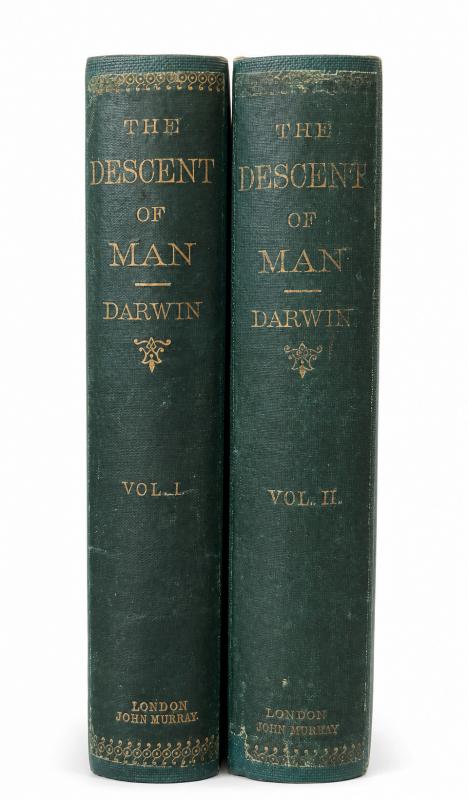
The Descent of Man. 2 Bände. With illustrations. London, Murray, 1871. VIII, 423, 16 Seiten, VIII Seiten, 1 Bl. (Postcript), 475 Seiten, 16 Seiten. Original-Rücken auf Modernen Lwd. mit RTitel. Erster Druck der ersten Ausgabe. - Bd. 1 mit "transmitted" als erstes Wort auf S. 297, Bd. 2 mit Errata verso Titel und Postcriptblatt nach S. VIII. Beide Anhänge mit Verlagswerbung "January 1871", in Bd. 1 betitelt "Popular Works", in Bd. 2: "Standard Works". - Garrison-M. 170 - Freeman, 937 - Norman, 599 - Mittelstraß I, S. 427-29 - Darwins „The Descent of Man“ ist eines der einflussreichsten Werke der Wissenschaftsgeschichte, weil es erstmals die Evolutionstheorie konsequent auf den Menschen anwendet, die sexuelle Selektion als zentrales Evolutionsprinzip ausarbeitet und grundlegende Annahmen über Herkunft, Variation und Einheit der Menschheit formuliert. Darwin argumentiert, dass der Mensch aus früheren Primatenformen hervorgegangen ist und damit Teil der natürlichen Evolution ist. Neben der natürlichen Selektion beschreibt Darwin detailliert, wie Partnerwahl und Konkurrenz um Paarungserfolg biologische Merkmale formen. Dies war neu und kontrovers. Darwin betont, dass alle Menschen einer einzigen Art angehören und eng miteinander verwandt sind – ein direkter Widerspruch zu damals verbreiteten rassistischen Mehr-Art-Theorien. Er vermutet, dass die Vorformen des Menschen in Afrika entstanden – eine Hypothese, die später durch Fossilien- und Genforschung bestätigt wurde. Insgesamt verbindet das Werk biologische, kulturelle und moralische Entwicklung des Menschen. Es zeigt, dass menschliche Vielfalt evolutionär erklärbar ist, ohne Menschen in „höhere“ oder „niedere“ Gruppen einzuteilen und markiert den Beginn einer wissenschaftlichen Anthropologie, die den Menschen als Teil der Natur versteht. - Vorsätze leicht gebräunt bzw. wenig stockfleckig, die Verlagswerbung am Schluß etwas stockfleckig, insgesamt gutes Exemplar. - First edition, first issue. – Vol. 1 with "transmitted" as the first word on p. 297; Vol. 2 with errata on the verso of the title page and the postscript leaf after p. VIII. Both volumes include publisher's advertisements dated "January 1871" at the end, titled "Popular Works" in Vol. 1 and "Standard Works" in Vol. 2. – Garrison-M. 170 – Freeman, 937 – Norman, 599 – Mittelstraß I, pp. 427-29.- Darwin's "The Descent of Man" is one of the most influential works in the history of science. For the first time, it rigorously applies the theory of evolution to human beings, establishes sexual selection as a central evolutionary principle, and formulates fundamental assumptions about the origin, variation, and unity of humankind.Darwin argues that humans emerged from earlier primate forms and are thus an integral part of natural evolution. Alongside natural selection, he describes in detail how mate choice and competition for reproductive success shape biological traits—a concept that was both groundbreaking and highly controversial at the time.Crucially, Darwin emphasizes that all humans belong to a single species and are closely related. This directly contradicted the widely held, racist polygenist (multi-species) theories of his era. He also hypothesized that early human ancestors originated in Africa—a premise later confirmed by fossil and genetic research. Overall, the work connects the biological, cultural, and moral development of humanity. It demonstrates that human diversity can be explained through evolution without dividing people into "higher" or "lower" categories, marking the beginning of a scientific anthropology that views humans as a part of nature.

Sachgebiete: Anthropologie, Völkerkunde/Ethnographie, Wissenschaftsgeschichte

30.07.2026 - 16:50

4850,- EUR

Jeschke Jádi Auctions Berlin GmbH