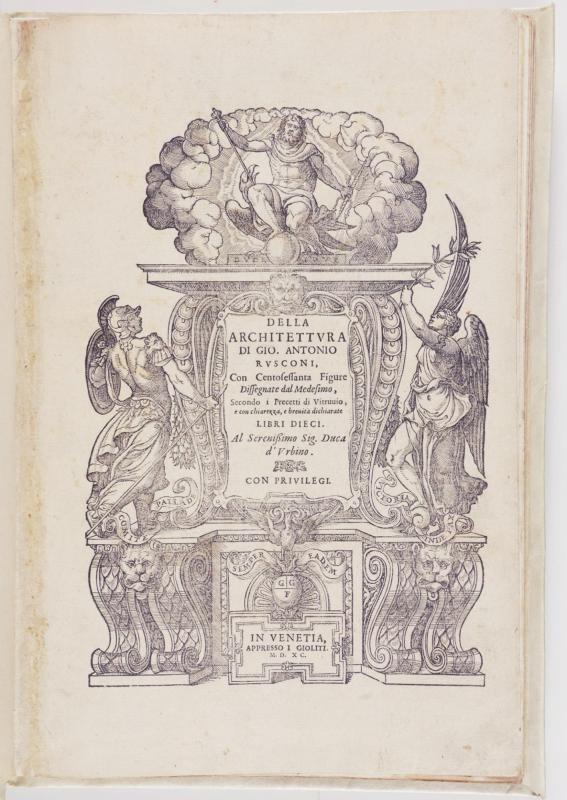
(Vitruvius Pollio, Marcus). Rusconi, Giovanni Antonio. Della Architettura di Gio. Antonio Rusconi, con centosessanta figure dissegnate dal medesimo, secondo i precetti di Vitruvio, e con chiarezza, e brevità dichiarate libri dieci
Venice. The Giolito Press [Giovanni II & Giovanni Paolo Giolito de Ferrara]. 1590. First edition. Small folio (27.3 by 18.7 cm). Signatures: a-c2, A-Z2, AA-NN2 (= 78 leaves). [xii], 143, [1, blank] pp. Title set within elaborate woodcut historiated borders; full- and half-page woodcut illustrations, plans, and diagrams throughout (a list of 144 figures appears after the contents); initials and ornaments. Recent period-style vellum; spine lettered in gilt; yapp edges, exposed thongs. Margins trimmed; occasional mild stains or smudges (mostly marginal). A nearly fine, crisp copy.
First edition, first issue (without errata) of "an unusual publication in the architectural literature of the sixteenth century [in which] a remarkably effective group of illustrations was married to an underelaborated text" (Millard). Antonio Rusconi (ca. 1520-1587) was introduced to the building trades and painting as a youth; he studied mathematics at the University of Padua under Giovanni Battista Memmo and Niccolò Tartaglia. He would serve as a hydraulic engineer for the Republic of Venice throughout his life. At the urging of Pietro Lauro, who had translated Leon Battista Alberti's De Architectura into Italian, Rusconi began in 1540 to prepare a translation of Vitruvius, with commentary, illustrated with more than 300 woodcuts. While his Venetian editors, Giolito and Tommaso Porcacchi, were accorded a publication privilege by the duke of Tuscany in March 1553, they decided not to publish the work, with so many editions of Vitruvius appearing at that time. After Rusconi's death in 1587, the Venetian publisher Giovanni Giolito decided to publish the woodcuts. Giolito died before the work went to press. "The commentaries to the illustrations published by Giolito's heir in 1590 were probably not by Rusconi, but the publisher may have desired not to waste the investment made in the already cut illustrations... The author refers constantly to Renaissance architectural theorists, such as Palladio, Bárbaro, Sebastiano Serlio, and Cesariano, turning the book into an extended discourse with a knowledgeable audience. Indeed, the author himself recognizes that the sketchlike quality of his publication disqualifies it as a fundamental teaching tool for architecture (p. 143: "poiche manco il fine e l'intention nostra è stata mai d'insegnarla con queste poche annotationi" [since our aim and intention has never been to teach it with these few annotations]). This author's main contribution is in the quality of the images... His illustrations display an unusual degree of independence from that of earlier commentaries on Vitruvius, revealing a marked anticlassical attitude (Millard).
The military and civil engineer Marcus Vitruvius Pollio (ca. 70-80 BCE - ca. 15 CE) is the author of the only surviving ancient treatise on architecture, arranged in ten books. By his own account, Vitruvius served in the Roman army under the command of Julius Caesar. Rediscovered by the Florentine humanist Poggio Bracciolini in the library of Saint Gall Abbey, and publicized by Leon Battista Alberti (1404-1472), Vitruvius’ De Architectura would later define the canon of classical architecture. His assertion that structures should exhibit the three qualities of stability (firmitatis), utility (utilitiatis), and beauty (venustatis) became a commonplace in architectural theory. The wide-ranging program of De Architectura deals with “principles of buildings in general, building materials, designs of theatres, temples and other public buildings, town and country houses, baths, interior decoration and wall paintings, clocks and dials, astronomy, mechanical and military engineering...” (PMM). Throughout the Renaissance, Vitruvius’ work provided inspiration for such important artists and architects as Michelangelo, Leon Battista Alberti, Donato Bramante, Lorenzo Ghiberti, Giacomo Vignola, Andrea Palladio and many others. The first printed edition of De Architectura appeared at Rome (ca. 1483-90); the first illustrated edition, at Venice (1511).
Provenance and annotations: Faint early entry in Italian at verso title (privilege); a few old underlinings in black ink at early leaves; old numbers appear in manuscript at some margins; old entry in Italian at bottom margin final text page. #55413
Sachgebiete: Architektur, Klassizismus, Wissenschaftsgeschichte, Italien, Renaissance
01.08.2026 - 00:57
7500,- EUR
Eric Chaim Kline Bookseller