Rare Books Berlin - Internationale Messe für Bücher und Graphik

...

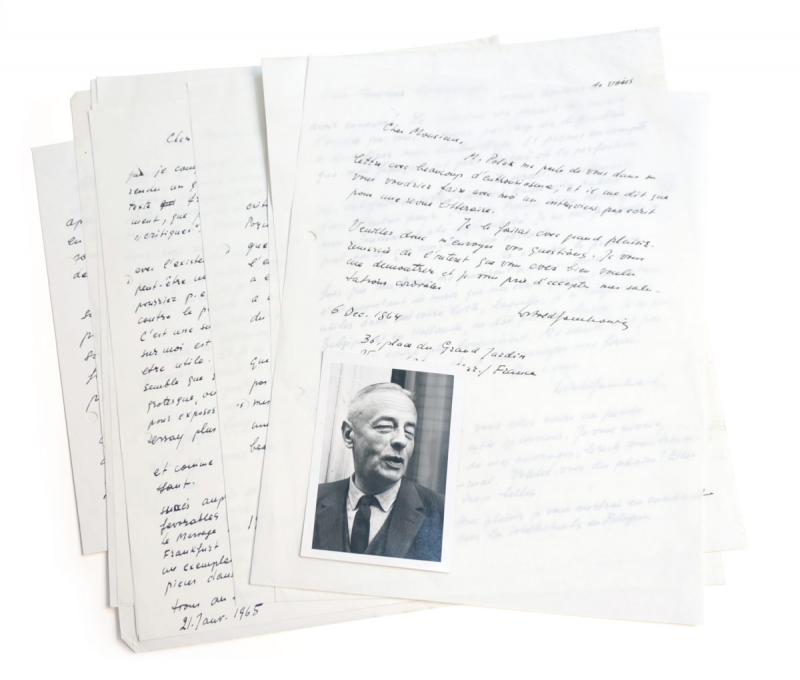
Furtwängler, Wilhelm. Furtwängler: collection of 12 items [SIGNED]

Germany. 1915-1951. Original document. A collection of twelve items concerning the important German symphony conductor: one large format photograph with personal inscription on mount, one signed photographic postcard, one original photographic portrait, three signed typewritten letters, two signed handwritten postcards, one signed music manuscript, one original press photo, a signed program of the Berlin Philharmonic Orchestra, and an unused photographic postcard. 1. Wilhelm Furtwängler Press Photo. Frankfurt, United Press. 7 x 9 1/2 inch original b/w photograph of Wilhelm Furtwängler conversing with Ernst Fischer. Fischer was the "Vorstand der Philharmoniker" (Manager of the Berlin Philharmonic Orchestra). A rare United Press - Acne Photo dated 23.5.50. Stamped address of publisher, as well as the names of the men depicted in the photograph written in blue ink on rear of photograph. Minor creasing to photo. Attached description of image typewritten in German on piece of paper on back of photograph. Very good condition. Rare. 2. Signed photograph, 6.8 x 9.2 inch photograph mounted on 11.6 x 15.6 inch photographer's mount. “Wilhelm Furtwängler,” n.p., 9th March 1944, with an inscription. A nice head and shoulders profile photograph of Furtwängler. Signed by Furtwängler to the photographer's mount. Also signed by the photographer “HR.(?)” Slightly stained and creased. Bottom left corner of photograph chipped. 3. Signed photograph, 3.5 x 5.5 inches. Signed “Furtwängler,” in ink beneath image, n.p. n.d. Rare b/w portrait photograph. Photograph by Fayer, Vienna. 4. Signed musical manuscript (4 1/4" x 5 1/2"). “Wilhelm Furtwängler,” n.p. n.d. [1948]. Minor age toning. Additional musical notes by Philippe Boegner slightly showing through from verso. Three bars of music from an unidentified composition. Furtwängler added, “In alter, über zwanzig jähriger unwandelbarer Freundschaft.” 5. Letter from Wilhelm Furtwängler to the Herrn Generalintendendanten, dated 12 September 1930. Signed by Furtwängler. Hole punched. One ink correction in his hand. Letter to the General Director of the Prussian State Theatre, Heinz Tiejten, who was director from March1930-1945. Letter deals with a production of “Walküre” to be performed at the Berlin opera. With a postscript concerning Frau Reinhart's role in the production. 6. Signed typewritten letter. “Dr. W. Furtwängler,” Berlin, 23rd October 1931. On his printed stationary. Hole punched and folded. Letter to the publisher Gustav Bosse about an article Professor Dr. Hans Joachim Moser wants to write about him. Furtwängler gives his approval. 7. Handwritten and signed postcard. W. Furtwängler, Mannheim, 1915 (postmark), to the violinist Melanie Michaelis (1882-1941), in German. Furtwängler writes, “…Thank you very much for the lines. I am in a tremendous hurry, so I can write only these few lines. I am looking forward to seeing you…” 8. Signed typewritten letter. “Wilhelm Furtwängler,” Mailand, 15th April 1951. With corrections in his hand. Slightly staining on right border. To publisher Erich Seemann (1888-1966). Furtwängler adds the date and place of upcoming performances of the “Berliner Philharmonikern.” 9. Handwritten and signed postcard. Mannheim, dated 29 May 1924. To a music publisher in Leipzig informing him that he will be in Frankfurt between the 10th-14th of June and that they can meet at that time. 10. Unused, 3 1/5" x 5 1/4" postcard of a b/w reproduction of a photograph showing Furtwängler reading a newspaper. Name in pencil twice on back, not believed to be signed by him. Very good condition. 11. Original photographic portrait of Furtwängler. 6 1/4" x 9" mounted on 8" x 11" card. Oxidized around outside edges beginning to encroach on the image. Circa 1935. Photographer not noted. 12. Berliner Philharmonisches Orchester. 4 page fold-out pamphlet of a concert by the Berlin Philharmonic Orchestra on December 19th, 1949. Cover leaf with b/w photographic reproduction showing Furtwängler. Inscribed and dated by Furtwängler in blue ink across portrait. Illustrated with various advertisements. Text in German. Folded and creased. Closed tear repaired with tape, lower right corner on last leaf with tape remnants. Fair condition WITH Square octavo 12 page pamphlet "Berliner Philharmonisches Orchester.'" Illustrated with one b/w reproduction of the conductor as well as advertisements. Text in German. Slight creasing to pages. good+ condition.

Sachgebiete: Kulturgeschichte, Deutschland, Instrumente (Musik), Photographie, Politik

01.08.2026 - 00:03

12000,- EUR

Eric Chaim Kline Bookseller

...

Lazi, Adolf. Twenty Photogravures Signed by Adolf Lazi with Original Manuscript Letter & various related Ephemera (Presentation Copy)

Freudenstadt. Self-published. Ca. 1925. Unique copy presented to Oberforstrat A. D. Holland on the occasion of his retirement. 4to. Original full vellum with gold borders and gold-stamped florets on spine. Gold-ruled raised bands. Top edge gilt. Binding designed by Adolf Lazi. Inside front board lettering in red within golden border: "Entwurf und Bilder von Adolf Lazi. Lazi-Verlag Freudenstadt." Free front and rear endpapers in parchment. Manuscript letter, dated "Klosterreichenbach den 22. Dezember 1925," pasted on free front endpaper thanking Mr. Holland for his many years of service at the Forstverband Freudenstadt. Following is a presentation leaf with finely handwritten dedication in gold to A. D. Holland, also on parchment. Signed by thirteen officials of nine forestry agencies with names of agencies also handwritten in gold. Text and signatures within double red border (* full text of presentation leaf below). Illustrated with twenty images in photogravure by Lazi of forest scenery in the Schwarzwald (Black Forest) and surroundings. Lazi's captivating images convey the tranquillity yet powerful landscape of the Black Forest. All photogravures signed in pencil by Lazi with handwritten captions by him. From 1918-1928 Adolf Lazi had his photo-atelier in Freudenstadt. Along with Albert Renger-Patzsch and Hans Finsler, Lazi was one of the most important artist of the "Neue Sachlichkeit" (New Objectivity) photography of the twenties and thirties. In 1936 he achieved worldwide recognition with his interior photographs of the airship "Hindenburg." WITH Additional related ephemera of 3 letters and two photos, laid-in. One letter by Forstrat G. Maier to "Herr Oberforstrat" (most likely A. D. Hoffmann), dated "Stuttgart, 4. Mai 1926. Maier is also one of the officials that signed on the dedication leaf. Verso of letter with pasted 2 1/2" x 4 1/4" photograph of 3 people walking their dog on a forest path. Second letter with unidentifiable writing, dated 23. XII. 25. Original 2 1/4" x 3 1/4" photograph of Forstrat Galser, dated on rear 25. IX. 1935. Second photo measures 3 1/4" x 4 1/4" showing a winter scenery of a bridge and a stream in Klosterreichenbach. Handwritten description in pencil on verso, dated 21. Dezember 1927. Typical rippling to parchment leaves and manuscript letter. Some staining on inside of front and rear board and on bottom corner of #32097dedication leaf. Very good condition. Photogravures clean and crisp. Unique presentation copy with all photogravures signed by Lazi. #32097

Sachgebiete: Botanik, Deutschland, Naturwissenschaften, Nordrhein-Westfalen, Photographie

01.08.2026 - 00:01

6000,- EUR

Eric Chaim Kline Bookseller

...

Frere, Joseph. Tractatus integer morborum infimi ventris cum observationibus practicis cuilibet morbo peculiaribus (A Complete Treatise on Diseases of the Lower Stomach with Practical Observations of Each Particular Disease) [18TH-CENT. MEDICAL MANUSCRIPT

[prior to 1750] Small quarto (19.5 by 14.8 cm). 351 (pp. 344 and 345 blank but for the note "hic nihil de est" -- there is nothing here), [2: blank], 352-449 (pp. 446-449 blank), [1: blank] pp. Bound manuscript. Text in Latin. Contemporary cat's-paw calf; gilt-tooled spine with raised bands, morocco lettering piece; marbled endleaves; edges stained red. Covers lightly rubbed with some scuffing at rear. Text crisp and fresh with a few scattered light stains. A very good or better copy housed in quarter faux leather slipcase with gilt lettering pieces. Eighteenth-century medical manuscript on diseases of the abdomen. The 30 sections, each treating a different malady, are consistently organized, beginning with a definition; followed by variations; causes; symptoms; diagnosis; prognosis; and cure. Approximately 140 pharmaceutical recipes appear throughout the curative regimens. Concluding dated observations of individuals treated by the author are provided for seven of the diseases discussed. The range of maladies includes, i.a., lack of appetite; disgust with food; heartburn; vomitting; hiccups; diarrhea; hemorrhoids; hepatitis; jaundice; edema; diabetes; nephritis; and dysuria. A brief introduction appears before the first chapter; a summary of definitions, followed by a table of chapters (with page numbers) concludes the work. Provenance and annotations: "Ex libris Josephi Frere medicinae doctoris" entered at front endleaf; recent bookplate of Otto Oren Fisher at front pastedown. At the end of the final chapter the author notes: hujusce tractatus a josepho frere artium magistro et medicinae alumno transcriptus (nunc medico 1750) / This treatise was transcribed by Joseph Frere, master of arts and student of medicine (now a physician in 1750). The last remark about becoming a physician in 1750 is penned in a lighter brown ink, as are the page numbers which appear throughout the text and in the concluding index. The author's dated observations range between 1725 and 1734. #18779

Sachgebiete: Geistesgeschichte, Judaica, Handschriften, Medizin

31.07.2026 - 23:58

6000,- EUR

Eric Chaim Kline Bookseller

...

Ganjavi, Nizami. Khosrow and Shirin [ILLUMINATED MANUSCRIPT WITH 8 EXQUISITE MINIATURES]

India. Ca. 1590. Manuscript. Two parts, tall octavo (21.8 by 11.5 cm). Manuscript with polychrome illumination; approximately 420 leaves, text recto and verso. Persian text in black and red ink on polished cream paper. Opening and central 2-page illuminated compositions; main text in two columns, 15 lines per page; 8 half-page polychrome miniatures; 3 pages with modest additional polychome illumination. Contemporary brown morocco wallet binding (expertly rebacked); covers with central gilt floral palmette surrounded by two smaller gilt devices. Section at bottom opening unwan leaf excised (with skillful reparation), resulting in loss of two lines of text and marginalia; several leaves with skillful repairs to fore-edges. Light smudges and stains throughout, otherwise very good, with clean miniatures. Housed in custom clamshell box. Epic poem by Nizami Ganjavi of Azerbaijan (1141–1209). Widely regarded as the greatest romantic epic poet in Persian literature, Ganjavi brought a more colloquial and realistic style to the Persian epic. His heritage is widely appreciated throughout central Asia, especially Afghanistan, Azerbaijan, Iran, Tajikistan, and the Kurdish regions. Khosrow and Shirin is the second work of his set of five poems known collectively as Khamsa; it offers a fictionalized account of the love of Sasanian emperor Khosrow II Parviz (590-628), the last great monarch of pre-Islamic Iran, for his Christian queen consort, Shirin. The basic story is already found in Ferdawsi's epic Shahnameh, and throughout the works of many other Persian writers and popular folk tales. Two full-page double suite compositions (Arab. 'unwan) with polychome ornamental headers and text within clouds on gilt background appear at the opening and again at the mid-way point of the work. The fifteen lines of the main text are situated within two sets of ruled borders: the first set in gilt and black tightly surrounds the text (13.5 by 6.5 cm); the second set in gilt, red and blue (18.5 by 9.5 cm) creates a space to surround the main text with commentary in black and red ink, penned diagonally. Breaks throughout the main text, ruled in red, contain divisional headings penned in red. The artist employs a wide palette of colors in the eight finely executed miniatures. Although illustrated in the style of late 16th-century Shiraz, the use of purples is unusual. Provenance: Unidentified 20th-century bookplate at verso final leaf, along with portion of excised catalogue description, noting "Oriental... On Love." Remains of old paper library label at spine. #55702

Sachgebiete: Arabistik, Buchmalerei, Islam, Literatur bis ca. 1900, Orient

31.07.2026 - 23:55

25000,- EUR

Eric Chaim Kline Bookseller

...

[Sagaun, Miguel; Bernardino Aznares]. Concordia aromatariorum Caesaraugustanensium [UNIQUE MANUSCRIPT COPY OF ONE OF THE EARLIEST KNOWN PHARMACOPEIAS]

[Spain] 1651. Manuscript. Large quarto (28 by 20 cm). Manuscript in brown ink. [4 (Sirup Regis Philippi; copy of title page; title page; blank)], [12 (Ad lectorem; Divisio libri; Carmina in laudem operis; Tractatus de po[n]derib[us] et mensuris; Declaracio[n] de los simples de Mesue)], [3]-177 (Epithome omnium antidotoru[m]; [Tractatus synonomorum]; Tractatus in quo precia omnium medicamentoru[m] simpliciu[m])...; Index antidotoru[m]), [5 (Index continued), [2 (addition recipes)] pp. Title within architectural frame (frame playfully copied by a somewhat later hand on the facing page with additional ornamentation. Contemporary vellum; manuscript title at spine (faded). Text in Latin and Spanish (Introducion; Los Simples de Mesue). Written throughout in a neat hand in brown ink. Due to the different quality of the paper, some quires are more tanned and foxed, and the ink ghosts stronger. Some staining and smudging throughout (but not obscuring text). Few leaves unevenly trimmed at the edges or corners. Page 75 with closed tear at lower gutter and inner margin, not affecting the text. A good or better copy on crisp paper. Unique manuscript copy of a 16th-century Spanish pharmacopeia. The present manuscript and a single surviving printed edition (Biblioteca de la Real Academia de Farmacia de Madrid) are the only early modern witnesses of this version of the text. One of the first pharmacopeias in the world, (preceded only by Florence and Barcelona), Concordia aromatariorum Caesaragustanensium, was printed at Zaragoza in 1553 by Stephen de Nagera (Esteban Godinez de Nájera) (Haebler, 1897) and is regarded as a revised and much expanded second edition of the 1546 Concordia aromatariorum ciuitatis Cesarauguste, printed by Pedro Bernuz and Bartolomé de Nájera. Besides the variant titles and authors (1546: Jerónimo Assín Mayor with Bernardino Aznares; 1553: Miguel Sagaun with Bernardino Aznares), the two works differ significantly in both structure and content, as well as in the terminolgy used for the various substances. Apart from a revised guide to pricing, the 1553 edition also includes a chapter on simple aromatics written in Spanish verse after Mesue ([Declaracion de] Los simples de Mesué), and a 10-page treatise on synonyms (Tractatus Synonomorum), in which a significant number of words appear in vulgar dialects, along with references to the classic works where they are cited, and guidance for the apothecary to substitute certain products with others to produce the same pharmacological effect. (Francés Causapé 2001, p. 17) (Devaux Guy, 2010). While the 1546 Concordia describes 248 formulations, the 1553 edition almost doubles this number to 447, and for the first time in pharmaceutical literature, classifies formulas containing opium as narcotics (stupefacentibus). (Blasco Nogués 2001, p. 7). Both Concordias are written in Latin (except for the Introduction and the aforementioned chapter on simple aromatics in the 1553 edition). They are based on the Galenic and Arabic traditions, the latter derived fundamentally from the works of Mesue (Yuhanna ibn Masawaih, ca. 777–857 , an Assyrian scholar and physician from the House of Gundishapur, one of the Sassanian centres of education). Other important influences include the medieval and Renaissance teachings of the Schools of Salerno and Montpellier, along with the French physician Guy de Chauliac, and the Italian surgeon Giovanni da Vigo. In the 1553 edition, the influence of the medical schools of Padua, Bologna, and Ferrara, along with the apothecary Giovanni Giacomo Manlio di Bosco, can be seen as well. (Devaux 2010) (Francés Causapé 2012). Written by Miguel Sagaun, then President of the Colegio de Boticarios de Zaragoza (College of Apothecaries of Zaragoza), and Bernardino Aznares (who collaborated in the writing of the earlier edition), the only known copy of the 1553 edition is held at the Biblioteca de la Real Academia de Farmacia de Madrid. It comprises a title page, a dedication to the reader (Ad lectorem) which explains the three main parts of the book, followed by a treatise on weights and measures (Tractatus de ponderibus & mensuris), an introduction in Spanish (Introducion), and the “declaration of the simples of Mesue” ([Declaracion de] Los simples de Mesué), a description of simple medical substances in Spanish verse in the genre of the Salerno School. The main text begins with the first part introduced in the Ad lectorem on antidotes (De Antidotis), divided into fifteen classes (pp. [3]-165 in our manuscript); the doses are indicated at the right margin, and many synonyms are inserted at the left, along with occasional explanatory notes. The remaining sections comprise the treatise on synonyms (Tractatus Synonomorum); the price list (Tarifa); and an Index. Our manuscript follows essentially the text and layout characteristics of the 1553 printed edition. Notably, the introduction to the price list (Tractatus in quo precia omnium medicamentorum...) is included, but the listing itself has been omitted. In addition, six extra formulations that could not be found in the printed edition are included, of which two are merged into the text, Pulb[is] hiere sim. Galeni on. pp. 56–57, and Unguentu[m] pleureticu[m] Mesue Cap. de aqua cicerum on. p. 147, and four written on the first (Sirup Regis Philippi)) and the last leaves (Ung. Cometisse […]; [unnamed]; Ung. Magistralis). The synonyms indicated on the left margins differ in places from the printed edition, some newly added to the manuscript, and some cancelled (just like the outdated price list). The closing Index here, unlike that in the only known printed copy (with major tear and gaps), appears to be complete. The dated colophon (1651) appears on p. 175, at the close of the treatise on synonyms. Provenance and annotations: Pascual Savall’s bookplate on inner front panel. The title written in pencil on the inner front panel in a later hand. A later sheet with bibliographical notes (Sanchez’s Bibliografia Aragonesa) mounted on the second free endpaper. Amended with several old, but somewhat later marginal notes in ink by another neat hand. Extra formulations written on the recto of the first leaf, and three more on the last leaf by a contemporary (probably the same) hand. This copy is mentioned in Dionisio Hidalgo’s Boletín bibliográfico español under no. 936 (Hidalgo 1864). Hidalgo claims that the printed book must have been extremely rare already in the 17th century, which is the reason for the existence of this manuscript of 1651. At the end of the entry, Hidalgo refers to the present copy, from “Biblioteca de D. Pascual Savall, en Zaragoza”, apparently Pascual Savall y Dronda, prosecutor (teniente fiscal) at the Zaragoza Court, (co)author of books on the legal history of Aragon and Zaragoza, and an eminent collector of books and manuscripts.


31.07.2026 - 23:52

35000,- EUR

Eric Chaim Kline Bookseller

...

Tacitus, Gaius Cornelius. Vita di Giulio Agricola scritta da Cornelio Tacito (Life of Julius Agricola written by Cornelius Tacitus) [MANUSCRIPT FROM THE THOMAS PHILLIPPS COLLECTION]

[Italy] 1650. Manuscript. Small folio (21.5 by 26.5 cm). 124, [1]pp. Contemporary sprinkled rustica boards, with manucript title at spine: "Vita di Agricola di Tacito." First leaf loose; touches of marginal foxing, else clean, easily legible text on crisp paper. Text in Latin and Italian (with corrections in same hand) on facing pages, 20-24 lines per page. Nearly fine copy. Manuscript (ca. 17th-18th cent.) text of Tacitus' Agricola in Latin and Italian, Phillipps MS 19272. The Italian translation does not correspond to either of the following early modern versions: 1. Giovanni Maria Manelli's La Vita di Giulio Agricola Scritta Sincerissamente (London: J. Wolfe, 1585), which appears to be a rare work. The present translation varies considerably from this earlier version. 2. In: Opera (Venice: Giunti, 1628; 1644), "trasportati dalla lingua castigliana nella toscana da D. Girolamo Canini d'Anghiari" [translated from the Castilian language into Tuscan by D. Girolamo Canini d'Anghiari] noted at title, but the caption title to the Agricola in the 1644 edition notes: "Tradotta in vulgar senese dal Signor Adriano Politi, & illustrata da D. Girolamo Canini" [translated into the Sienese vernacular by Signor Adriano Politi, and illustrated by D. Girolamo Canini]. Written around 98 C.E., "Agricola" is Tacitus' first historical work. It recounts the life of his father-in-law Gnaeus Julius Agricola, an eminent Roman general. It also covers, briefly, the geography and ethnography of ancient Britain. As in the Germania, Tacitus favorably contrasts the liberty of the native Britons to the corruption and tyranny of the Empire. The work has a strong anti-despotic tone and contains eloquent and vicious polemics against the rapacity and greed of Rome. Tacitus sets the despotism of Domitian against the merits of Agricola: an incorruptible officer and a great commander, who fitted the model of the mos maiorum ("the custom of the forefathers", the presumed superior morality of an earlier time). The writer implicitly says that, as the Empire should be accepted as a necessary evil, one has to keep one's dignity without mixing up one's own responsibility with the responsibility of an arbitrary despot like Domitian. One can be an honest and scrupulous officer, doing his job with serenity and in collaboration with the regime, keeping his job and keeping the interest of the state, waiting for a better age, when a writer would be able to write in freedom. Provenance and annotations: Small printed label at spine tail with library number "12972" (Phillipps MS 12972 noted in pencil at bottom margin of the first leaf); old label with number "164." affixed to front board. Printed label affixed at rear pastedown, "Carleton P. Small," with the following information added in ink: 11/15/29; [case] 7; [section] 4; [remark] Portland, Maine; [no.] 993; 17th Cent. MS. Sir Thomas Phillips (1792-1872) assembled one of the largest private collections ever, comprised of manuscripts, books, paintings, drawings, prints, photographs, and other materials. The manuscript portion alone numbered between forty- and sixty thousand items largely collected from the dispersal of religous libraries in France and Italy in the late eighteenth- and early nineteenth centuries. Reference: Catalogus librorum manuscriptorum in bibliotheca D. Thomae Phillipps, no. 12972 (p.229): "Taciti Vita Agricolae, Latin and Italian, pp. 124." #18737


31.07.2026 - 23:42

5000,- EUR

Eric Chaim Kline Bookseller