Rare Books Berlin - Internationale Messe für Bücher und Graphik

...

[BEVERSEN, Nicolaas Johannes].

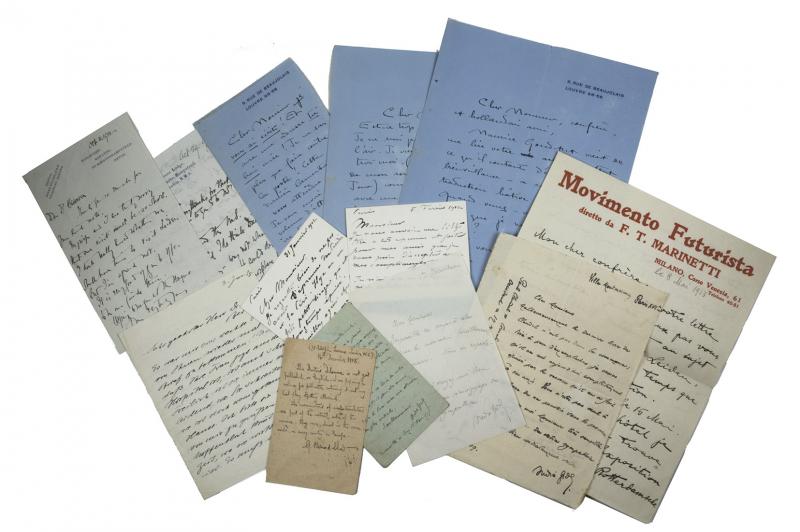
Extensive correspondence with artists and writers in fin de siècle Europe [Collection of letters and postcards received by Nicolaas Johannes Beversen]. [Various places in Europe, 1886-1931]. 825¾ pages on 550 leaves. An extensive collection of correspondence by the Dutch classical scholar, translator, book collector and literary critic Nicolaas Johannes Beversen (1860-1932), who received the letters and postcards, written by more than 90 correspondents, over a period of 45 years. Most of his correspondents were writers or artists including Théophile de Bock, P.C. Boutens, Colette, Georges Duhamel, Henri Fantin-Latour, Paul Fort, John Galsworthy, André Gide, Paul Herrmann, Ricarda Huch, Käthe Kollwitz, Melchior Lechter, F. T. Marinetti, Romain Rolland, Annie Salomons, George Bernard Shaw, Stijn Streuvels, Arthur Symons Émile Verhaeren and T.J. Cobden Sanderson (proprietor of the Doves Pres). A contemporary described Beversen, a voracious collector of Dutch, French, English and German literature, as both a quick and thorough reader. He kept himself informed on all new publications, often corresponding with the authors about when their work would appear. The British writer John Galsworthy (1867-1933) wrote Beversen in 1922, stating his thoughts on Charles Dickens: "I safely received the MS. Yes, I’m afraid I do think Dickens - great as he was - was not what I call a poet." In one of three letters, the French writer Colette (1873-1954) wrote about finishing the second part of La naissance du jour (1928) and promised to have the photographer Henri Manuel send Beversen her latest portrait, where "the two cats are magnificent", thereby dating a famous (and undated) photograph. Many other letters discuss lectures and conferences. Ricarda Huch stated in 1912 that she had a firm dislike of lectures that could not be changed. A year later, the Italian poet Filippo Tommaso Marinetti (1876-1944) regretted that he would not be able to attend a conference in Leiden, as he would be speaking at a Futurist exhibition in Rotterdam.

Sachgebiete: Autographen, Europa, Handschriften, Literatur ab ca. 1900

29.07.2026 - 11:03

28000,- EUR

Antiquariaat Forum BV

...

Grote, Ludwig (foreword)

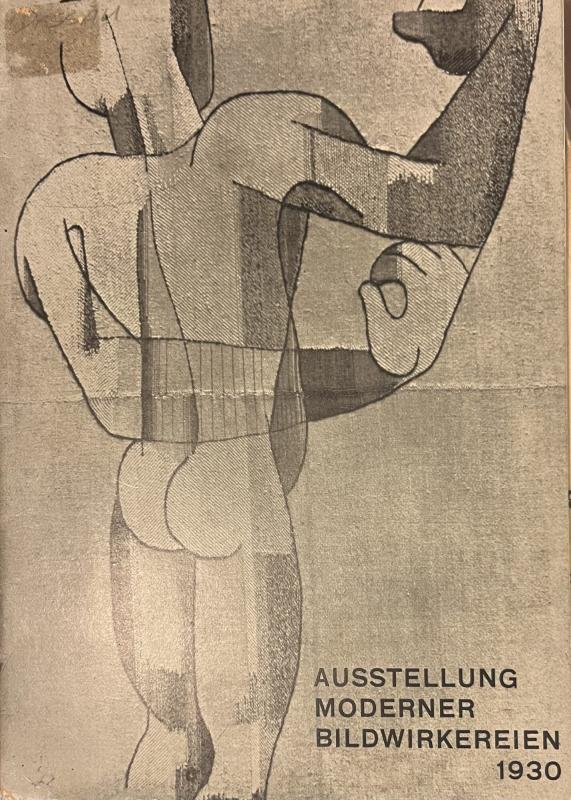
Ausstellung moderner Bildwirkereien 1930. Dessau: 1930. First edition. Original wrappers. [16] p. Small stain to the upper left corner of the cover. Rare Bauhaus catalogue presenting modern tapestry as an avant-garde artistic medium. Rare Bauhaus exhibition catalogue, printed in characteristic modernist typography, documenting the traveling exhibition of modern tapestry (Bildwirkerei) initiated in Dessau. Illustrated with 15 images in the text and two on the covers. The catalogue presents weaving as an autonomous artistic medium within modern art, reflecting its central role in the Bauhaus workshops. In his introduction, Ludwig Grote acknowledges Gunta Stölzl and Anni Albers for their role in assembling the material, underscoring the direct connection to the Bauhaus weaving workshop. Grote, a Dessau-based art historian closely involved in the institutional history of the Bauhaus, situates the exhibition within the broader development of modern applied arts. The exhibition included 59 works, with contributions by Sophie Taeuber-Arp, Ida Kerkovius, Ernst Ludwig Kirchner, Christian Rohlfs, Karl Schmidt-Rottluff, Gunta Stölzl, Ruth Hollos, Hans Arp, and Fernand Léger, among others, demonstrating the intersection of avant-garde art and textile practice. The graphic design is attributed to Oskar Schlemmer, with parallels to his later exhibition catalogue for Galerie Flechtheim (Berlin, 1931).

Sachgebiete: Architektur, Bauhaus, Design, Moderne Kunst

29.07.2026 - 11:01

2000,- EUR

Foldvaribooks

...

[ALBUM AMICORUM - EQUESTRIANISM - HERALDRY].

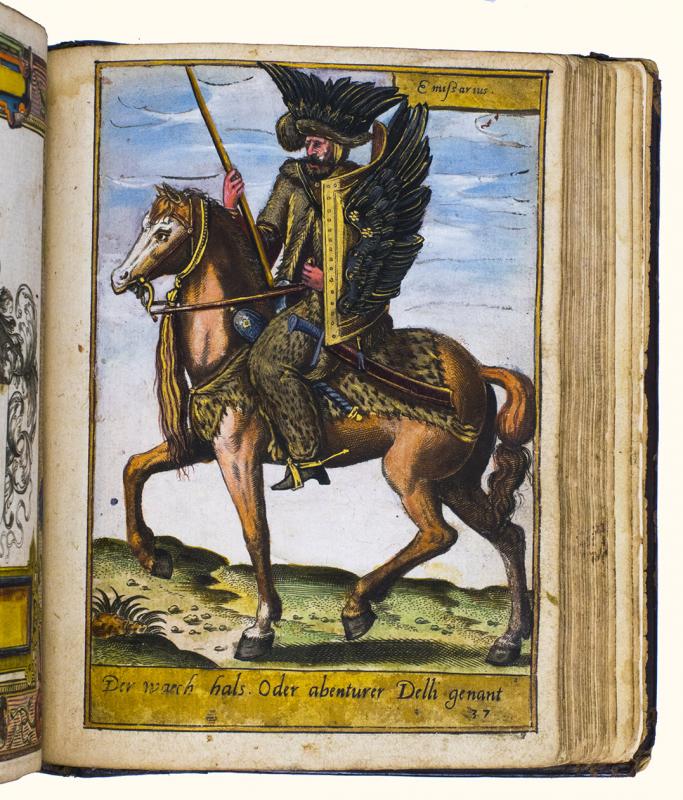
Beautifully illustrated hand-coloured and highlighted in gold album amicorum in an elaborately gold- and blind-tooled binding dated 1590 [Late 16th- and early 17th-century album amicorum]. [North-western Europe (specifically the vicinity of Brussels?)], [1585-1615]. 4to. With 45 hand-coloured and highlighted in gold engraved plates of horses and their riders from Europe, North Africa, and the Near and Middle East, numbered 1-50 (skipping nos. 2, 21, 27, 35, and 36), 46 hand-coloured and highlighted in gold engraved heraldic plates (sometimes filled in with manuscript notes), 2 hand-coloured manuscript coats of arms on l. 15v, and 1 black and gold hand-coloured manuscript coat of arms on the back paste-down. Contemporary elaborately gold- and blind-tooled mottled calf, with gold lettering on both boards (front: RVB HZC VFB C.) (back: 1590). A remarkable album amicorum containing numerous late 16th- and early 17th-century inscriptions, bound in an elaborately decorated binding (dated 1590) and including more than 90 expertly hand-coloured and highlighted in gold engraved plates on equestrianism and heraldry. The engraved plates of horses (and in two cases dromedaries) and the nine pages of explanatory printed text at the beginning of the album were based on a late 16th-century work by the Flemish engraver Abraham de Bruyn (ca. 1539-1587), titled: Equitum descriptio, quomodo equestres... (ca. 1575/76). This work was published again in Cologne in 1577 with the following title Diversarum gentium armatura equestris; each engraving shows a horseman from a particular country or region, including Germany, the Low Countries, France, Ireland, Italy, Spain, Russia, Romania, Hungary, Poland, Turkey, Persia, Egypt, Arabia, and more. De Bruyn's set of engravings was altered and expanded by the Flemish artist, Caspar Ruts (1530-1607), who later moved to Germany. Ruts (or Rutz) added two different types of plates meant for drawing coats-of-arms and family crests: the first type shows a crest flanked by a woman and a man (signed in the plate "Caspar Ruts excudit") and the second shows a crest in an ornamental frame. This frame is present in several versions: one type contains fruit and insects; a second one contains parrots, squirrels and fruit; a third shows flowers, berries and butterflies. Many blank pages and several engravings are inscribed in ink. Several of these inscriptions are dated, mainly between 1585 and 1615. These inscriptions are made by, for example, Rene de Barnaige (an alderman from Kortrijk, or Courtroi), Jeane(?) Dontremont, Odile de Wilzt, Anne de Brecht, René de Chalon, Konstantin I, Freiherr Fugger, Herr zu Zinnenberg (1569-1627), Marguerite de Horion d'Ordenge and many more. Most of the contributors to the album are from Northwest Europe (the vicinity of Brussels, the Low Countries and Rhineland). Several belong to the bourgeoisie and minor nobility of the Southern Netherlands. René de Chalon (d. 1624) is a grandson of the first Prince of Orange, also named René de Chalon (1519-1544). René de Barnaige owned a fiefdom, his entry is a remembrance "tout se passe ... sans elle ne puis" of Lady Antoinette de Bourgogne (1529-1588). Odile (Marie) de Wiltz was a daughter of Johann Freiherr von und zu Wiltz (1535-1607). Little else is known about her, except that she married Charles de la Hamaïde (1580-1649) and that she was a descendent from Johann I von Nassau Dillenburg and Egbert I van Amstel, therefore, a distant relative of René de Chalon.  

Sachgebiete: Handschriften, Heraldik, Pferde, Stammbücher

29.07.2026 - 10:59

35000,- EUR

Antiquariaat Forum BV

...

Slopianka, Alfred

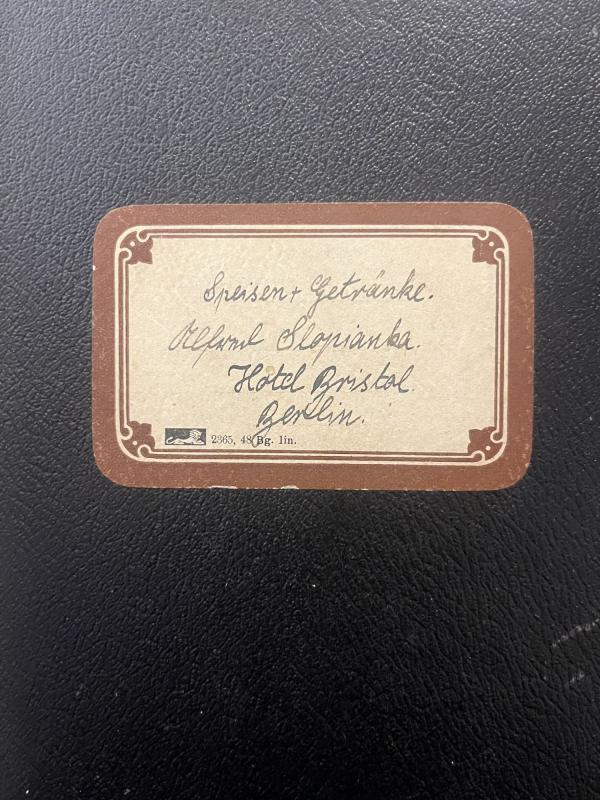
[Hotel Bristol, Berlin.] Speisen und Getränke. Alfred Slopianka. Hotel Bristol Berlin. Berlin: Undated, but circa 1930. Manuscript. Accompanied by several loose notes, all related to gastronomy, including lists of beef cuts, additional dish descriptions, a translation of German dishes into French, a typewritten list of regional specialties, and a printed operational regulation for the Hotelbetrieb-Aktiengesellschaft Bristol, Kaiserhof, Bellevue, Baltic, Centralhotel from 1935. Bound in contemporary half-cloth, with hand-cut index tabs. In a larger scrapbook-style volume, with more than 30 pages containing entries in German, while the rest remain blank. In fine condition. A unique handwritten gastronomic reference book from the 1930s, compiled by a Hotel Bristol waiter, documenting dishes and beverages. Handwritten recipe book belonging to Alfred Slopianka (b. 1916), a waiter at the Hotel Bristol in Berlin, one of the city's most prestigious luxury hotels. Rather than offering precise recipes with measurements, the manuscript provides descriptions of various dishes and beverages, listing their ingredients in a way that suggests it was meant as a reference for explaining dishes to guests or for personal use in service. Today, it provides valuable insight into the diverse and refined offerings of the hotel’s restaurant, reflecting the sophistication and breadth of its cuisine. The content is organized into sections, including Appetizers (1), Soups (28), Egg Dishes (8), Fish (16), Sauces (24), Garnishes, Meat Dishes (13), Vegetables, Salads (3), Desserts (18), and two sections dedicated to beverages: ‘Amerikanische Getränke’ (American Beverages) and ‘Alkoholische Getränke’ (Alcoholic Beverages). Additionally, the manuscript includes a section on lobsters and oysters (2), a glossary of Fachausdrücke (technical terms) explaining five preparation methods, and a seasonal dishes (Saisongerichte) section spanning two pages, listing different meats and fish alongside the months in which they were typically served, with additional notes (Vermerke) on a few vegetables. A double-page chart details cooking and roasting times for various meats. The ‘Amerikanische Getränke’ section contains a description of American Grog, while the ‘Alkoholische Getränke’ section is more detailed, listing eleven drinks with more than just their ingredients—some include preparation instructions. Among them are five classic cocktails: Absinthe Cocktail, Champagne Cocktail, Manhattan Cocktail, Manhattan Dry Cocktail, and Martini Cocktail—as well as Queen Charlotte (a variation of the Stinger), Milk Punch, Prince of Wales, Prairie Oyster, Sorbet, and Sherry + Egg. These selections reflect an awareness of international drinking culture and the refined tastes of the hotel's clientele. Founded in 1891 on Unter den Linden, the Hotel Bristol was an institution of Berlin’s cosmopolitan elite, attracting aristocrats, diplomats, and intellectuals. Renowned for its excellence in service and hospitality, the hotel became a symbol of sophistication in the city. Author Vicki Baum, who later gained fame for her novel Menschen im Hotel, worked there as a chambermaid, gathering material for her portrayal of grand hotel life. The manuscript, with its precise notations, appears to have been a working tool, either for assisting in guest service or as a practical reference behind the scenes.

Sachgebiete: Autographen, Gastronomie, Handschriften

29.07.2026 - 10:41

3000,- EUR

Foldvaribooks