BENJAMIN, Walter.
Einbahnstrasse. Berlin: Ernst Rowohlt, 1928.

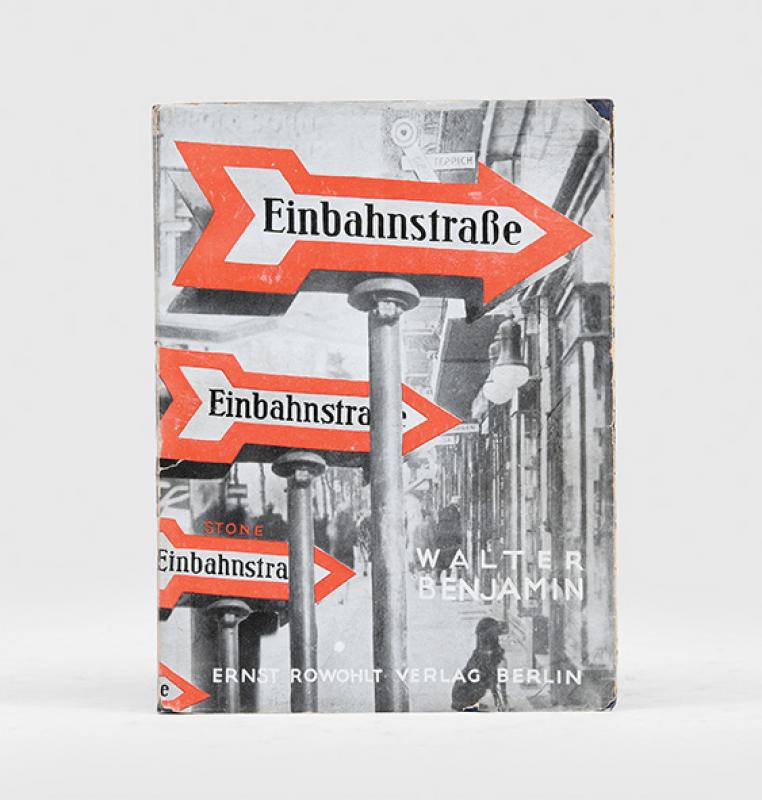
Octavo. Original photomontage wrappers with flaps over blue card, printed in red, white, and black. Housed in custom black quarter morocco chemise with grey board sides, and grey board slipcase, by Devauchelle. Wrappers bright, a couple of shallow chips to edges, small puncture to rear wrapper, front joint and front flap fold partially split, brown spot to fore edge. A very good copy of this fragile publication.

Scarce first edition of the philosopher’s literary reflections, his only non-academic work that he lived to see published. “In its typeface and format - a photomontage by Sasha Stone adorns the cover - as well as in its fragmentary style, it is demonstrably one of the most significant products of the German language avant-garde in the 1920s” (Witte, p. 91).
This work denounces the “pretentious, universal gesture of the book” to champion the immediacy of language in flitting fragments of text - street signs, leaflets, brochures, articles, and placards. The medium of Einbahnstrasse reflects this message: the typography and layout are inspired by Bauhaus and constructivist aesthetics, while the street-scene cover design has become the most famous work of the Russian-born photographer Sasha Stone. Since writing his postdoctoral work The Origin of German Tragic Drama in 1925, Benjamin had became a prominent cultural critic and “a prolific book-reviewer, travel-reporter, and radio-scriptwriter, forsaking his more esoteric diction for an often disconcertingly concrete language, metaphysical for more topical terrains” (publisher’s note, 1997, p. 33).
“The pivotal position of One-Way Street within Benjamin’s work, however, is not due only to its compact register of the sudden mutation in his critical, aesthetic, and political opinions in the mid-twenties. It above all lies in the fact that in the same swift movement with which Benjamin passed from the banks of tradition to those of the avant-garde, he also discovered the heuristic method that was to be peculiarly his thereafter - ‘the attempt to establish,’ as he would later write, ‘the image of history even in its most inconspicuous fixtures of existence, its rejects’. The kaleidoscope of urban objects, warnings, buildings, amusements, signs was designed to throw sudden light on the modern epoch” (publisher’s note, 1997, p. 35). The one-way street Benjamin leads the reader through acts as a panorama of 1920s Germany, terminating at the planetarium, “a space from which to look up - whether to the heavens or the cosmos - and recall what we cannot see” (Wallace, p. 284).
Among this montage’s flashes of essays are “Fire Alarm”, "Imperial Panorama", “Monument to a Warrior”, and “Principles of the Weighty Tome, or How to Write Fat Books”. This copy is from the significant collection of Pierre Bergé (1930-2017), the co-founder of Yves Saint Laurent, with his book label loosely inserted.

“Publisher’s Note”, One-Way Street, and Other Writings, 1997; Jack Wallace, “Book Review”, Quarterly Journal of Speech, Vol. 101, No. 1, February 2015; Bernd Witte, Walter Benjamin: An Intellectual Biography, 1991.
Sachgebiete: Deutschland, Literaturwissenschaft, Literatur ab ca. 1900, Philosophie
28.07.2026 - 18:35
15000,- EUR
Peter Harrington