Rare Books Berlin - Internationale Messe für Bücher und Graphik

...

Cicero, Marcus Tullius.

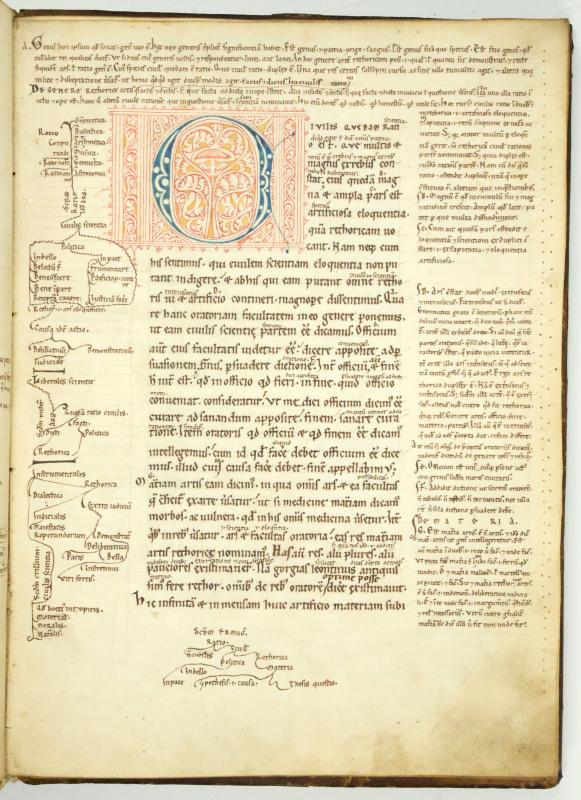
De inventione. Probably Rein Abbey, Styria, c. 1100. Folio (240 x 330 mm). 58 ff., complete. Latin manuscript on vellum, early protogothic script in three hands, ruled in lead-point with double prickings. 14th/15th-century blind-tooled leather over wooden boards, brass corner-pieces, edge guards, catches and remnants of clasps; later paper title-label to spine. Stored in a custom protective case. With rich illustrations, diagrams and glosses, this stunning manuscript of Cicero's earliest work on rhetoric is also of remarkable dimensions: only one other pre-1200 manuscript of comparable size is known, in the Bodleian Library in Oxford. The marginal additions are no less notable, containing hitherto unattested, longer versions of the so-called "Carmina Runensia", some of the oldest poetry known from Austria. This volume thus represents a once-in-a-lifetime find, providing us with an unparalleled testimony to the medieval study of classical rhetoric as well as poetic production. Immediately striking are the finely executed interlinear glosses, providing simpler alternatives to Cicero's elevated vocabulary, showing the attention that went into crafting this volume as an aid to teaching and learning. This is further illustrated by the marginal commentary providing background and elaboration, and the multiple diagrams (four full-page, one two-page) illustrating the flow of an argument with great detail and clarity. They are notably more comprehensive than similar examples in other manuscripts of the text, and were carefully planned as part of the volume, being executed in the hand of the first of the two main scribes. Unique to this manuscript are two extremely rare poems in Leonine hexameters preserved in the margins, written in a later, third hand: in one, the twelfth-century poet Meginardus praises Cicero while damning other classical authors; the second, possibly also by Meginardus, is a paean to the glories of spring. These poems are otherwise only known from a single codex, held by the Abbey of Rein in Styria. Known as the "Carmina Runensia", they are among the earliest examples of poetic art from Austria. Notably, the versions in this codex contain some 800 extra, hitherto unedited lines, providing a vital new witness to these texts. Together with palaeographical and codicological considerations, this suggests that our codex was also produced at Rein, or at least in Austria or Southern Germany. This conclusion is strengthened by the use of the commentaries both of Victorinus and Grillius, which were known in the region, being attested in the library of Tegernsee Abbey, among others. The manuscript was later in the possession of the "Domus Dei" in Trento, a community of flagellants established c. 1340. Their ownership-mark with a scourge appears throughout the text in the margins and on the front leaf. The attractive leather binding, still with its metal fixings and the remnants of clasps, was produced in the later fourteenth or early fifteenth century. Written while Cicero was still a young man, 'De inventione' is one of the oldest tracts on rhetoric to survive in Latin. Although in his old age he considered the text eclipsed by his more mature works on the subject, it remained an incredibly popular piece, both in antiquity and the Middle Ages. Beyond its explicit subject, namely the invention of rhetorical texts, Cicero also explores philosophical themes, including the foundations of a just society on notions of duty, gratitude and loyalty to the truth. In 'De inventione', we thus see the germination of Cicero's idea that philosophy and oratory could never truly be separated. A great rarity: most manuscripts of 'De inventione' are small, normally in octavo format, the only comparable pre-1200 example being in the Bodleian Library. Rare Book Hub records only three sales of manuscripts of 'De inventione' over the past 100 years, the only one of similarly early date appearing in 2001. A remarkable and unique witness to one of Cicero's earliest and most defining texts.

Sachgebiete: Antike, Handschriften, Klassizismus, Philosophie

02.09.2026 - 12:51

580000,- EUR

Inlibris GmbH

...

Michelangelo.

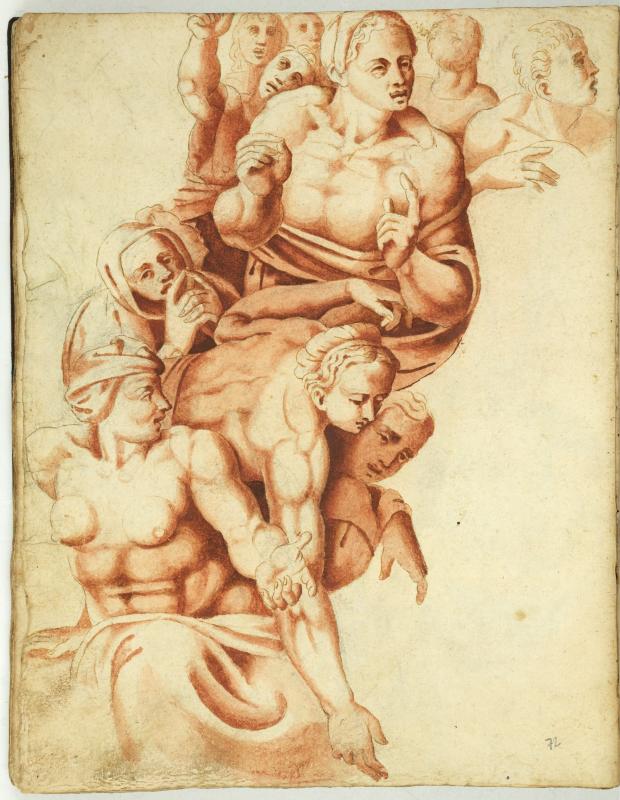
Album with 70 ink and wash studies after the "Last Judgment", preserving Michelangelo's original fresco designs. Rome, ca. 1560. Small folio (210 x 270 mm). Album of 70 mostly double-sided drawings, rendered in ink, with watercolour in bistre, sepia, lapis lazuli, and sanguine. 37 ff. (misnumbered "40", in ink in the upper right corner). Collation: a14, b10, c12, d1 (singleton); ff. 15v, 23v, 24r, 25v blank. The watermark indicates the paper was produced in Rome around 1560. Early 18th century brown morocco, covers within gilt floral frame. Smooth spine, richly gilt-tooled, title lettered in gilt, rather faded. Marbled pastedowns and flyleaves. Stored in a custom-made purple full morocco box. Album of seventy studies after the "Last Judgment", preserving Michelangelo's original fresco designs and thus almost certainly made during his lifetime, as the frescoes were bowdlerized on the orders of the Council of Trent shortly after his death in 1564. From the famous library of the Italian art historian and collector Leopoldo Cicognara (1767-1834). The figures from "The Last Judgment" are rendered with such precision as to suggest the artist's intimate familiarity of the original work: obviously, he either saw the work in person, having joined Michelangelo on the scaffolding, or he must have had access to the original, now-lost cartoni of the frescoes. Most importantly, the drawings show the figures in their original state as painted by Michelangelo. After his death in 1564, the male genitalia in the frescoes, regarded as objectionable, were covered with drapery by the artist Daniele da Volterra, thenceforth known as "Il Braghettone" ("the breeches-maker"). The frescoes were only partly restored to their original stage in the 1980s. This album therefore stands as an important and early first-hand iconographical documentation of Michelangelo's masterpiece. The proximity to the work in its original state, as well as the expensive colours and materials employed (including ultramarine, by far the most costly and treasured colour, made from the precious powder of crushed lapis lazuli), suggest that this very elegant album was at least not made by a student. It is also possible that the album is the product of different hands from the same pictorial school, since some of the drawings, particularly that on fol. 16, appear to have been executed by a more mature hand with a stronger and steadier stroke, while remaining stylistically consistent with the rest of the drawings. It also appears that the artist was so concerned with the Hellenic perfection of Michelangelo’s nude bodies that the drawings are unnaturally cropped in order to exclude every other element of the pictorial background: it therefore stands to reason that the album was realized by someone who had in mind the importance of nudity in Michelangelo's work and, perhaps, the sin of overpainting his astonishing masterpiece. Michelangelo's "The Last Judgment" ("Il Giudizio Universale"), executed on the altar wall of the Vatican's Sistine Chapel, is widely regarded as one of the most important artworks of all time. It depicts the Second Coming of Christ and God's final and eternal judgment of all humanity, with humans rising and descending to their fates as judged by Christ, who is presented surrounded by prominent saints. Completed in four years, between 1536 and 1541, it ended up being censored by the Catholic church: the album of drawings presented here captures a substantial part of the fresco in its original state, marking a critical moment in its history as well as that of art in general. Michelangelo’s fresco - an exquisite example of his keen attention to musculature and the naked body - was the subject of intense debate between those who appreciated the artist's aesthetic genius and Mannerist style, and, on the other hand, critics from the Catholic Counter-Reformation who accused the work of being insensitive to proper decorum, and of flaunting personal style over appropriate depictions of content. After the Pope's Master of Ceremonies, Biagio da Cesena, stated that "it was most disgraceful that in so sacred a place there should have been depicted all those nude figures, exposing themselves so shamefully", and that it was no work for a papal chapel but rather "for the public baths and taverns", Michelangelo retaliated by painting Cesena's likeness onto the face of Minos (judge of the underworld, whose inclusion here, along with that of Charon, was inspired by Dante's Inferno), with donkey ears suggesting foolishness and a coiled snake biting his membrum. It is said that when Cesena complained to the Pope, the pontiff joked that his jurisdiction did not extend to hell, so the portrait would have to remain. The debate grew steadily, and a few years after the fresco was completed, the decrees of the Council of Trent urged a tightening-up of church control over "unusual" sacred images; thus, after Michelangelo’s death in 1564, the genitalia in the fresco, regarded as "objectionable", were covered with drapery by the Mannerist artist Daniele da Volterra. Volterra was the first in a series of 'braghettoni' painters to cover the original frescoes with multi-coloured veils and other deceptions to keep Michelangelo's work from being seen in its original incarnation. He is also responsible for chiselling away part of the fresco and repainting the larger part of St Catherine and the entire figure of Saint Blaise behind her. This was done because in the original version the latter appeared to be looking at the former's naked buttocks, and to some observers the position of their bodies even suggested intercourse. St Catherine, who had been nude, was redressed in a green and yellow smock; St Blaise, who was bowed down, was repainted in an upright position with his head turned in a direction opposite to that which had been painted by Michelangelo, thus ruining the geometry of the scene and distorting the meaning of the work. The fresco was restored along with the Sistine vault between 1980 and 1994 under the supervision of Vatican Museum's curator Fabrizio Mancinelli. Over the course of the restoration about half the censorship from the "Fig-Leaf Campaign" was undone, and numerous other buried details, trapped under years of smoke and grime, were revealed; indeed, it was only after this restoration that the coiled snake biting Biagio de Cesena's genitalia was revealed once more. Remarkably, all these details - lost or altered after the 'Braghettoni' covered the fresco - and, perhaps most importantly, the destroyed portion of St Catherine and St Blaise, are reproduced in this elegant collection of drawings - a rare and extraordinary curiosity, and a contemporary art historical source worthy of further study. As a note on the front flyleaf attests, the album later belonged to the outstanding Italian art historian and collector Leopoldo Cicognara, well known for his celebrated art bibliography. Throughout his collecting and writing, Cicognara amassed a fabulous art library, the inventory of which - published in 1821 - may today be his most consulted text. He was highly esteemed by his contemporaries such as Goethe, Quatremère de Quincy, Giordani and Monti, David and Canova.


02.09.2026 - 12:39

450000,- EUR

Inlibris GmbH

...

Biblia Georgiana.

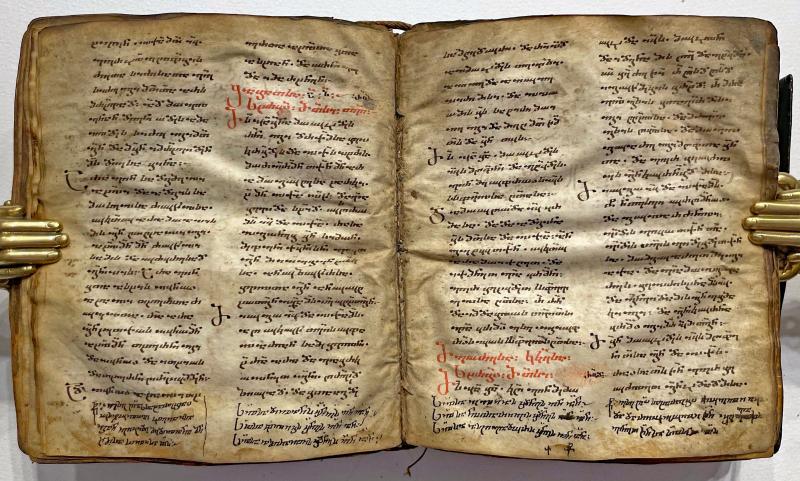
Georgian Gospel Lectionary. Greece or Southern Caucasus, c. 1200. 4to (170 x 192 mm). 226 ff., missing some leaves, including at beginning and end. Georgian manuscript on vellum. Armenian quire-signatures. Written in Khutsuri script, black ink with red initials and rubrics in two columns. Full leather binding of c. 1600 over wooden boards, alla greca style, tooled in blind with a large cross pattern within a decorative border on the front cover. Fore-edge semi-flap, remains of ties. Stored in a custom-fitted black half morocco case with gilt spine title by P. Goy & C. Vilaine. Rescued and restored around 1600 CE as an act of devotion, this Gospel book represents an extremely rare occurrence, namely the appearance of a hitherto unknown medieval Georgian codex. Offering extensive readings from the revised "Athonite" text of the New Testament produced by medieval scholars, this volume is an extremely important witness to one of the most understudied Biblical traditions. "I, Dilana, bought this holy Gospel from some infidels" can be found in an early modern Nuskhuri hand on f. 53v. The price is stated as having been 10 pluri (florins) for the Gospel and a basin. Dilana then had the book rebound, probably in the surviving Greek-style (alla Greca) binding. At some point, quire signatures were written in Armenian numerals. The term "infidels" may point to Muslims, or perhaps also from Roman Catholics: the stated price in "pluri" ("florins") points to an area where western, in particular Italian currency was in circulation. Such coins would have been known in Greece, home to the Georgian monastery Iviron ("of the Iberians", i.e. Georgians) on Mount Athos. It was there that a group of scholars, beginning with Euthymius the Athonite (d. 1024), began correcting the old Georgian Gospel translations against the Greek originals, to provide their countrymen with a more accurate understanding of the Word of God. Although Georgia was one of the first countries to adopt Christianity as an official religion (in 319 CE), the earliest Georgian versions of the Gospels seem to have been translated from Armenian rather than Greek. This volume thus captures the Georgian Gospel tradition at a crucial crossroads. Dr Adam Bremer-McCollum has established the text of our manuscript as that of the Athonite revision and dated it to the thirteenth century, while Dr Timothy Bolton has argued for a slightly earlier dating of the eleventh to thirteenth century on the basis of its palaeographical features. The Khutsuri script used by the scribe arose from the tenth century onwards as a mixture of Asomtavruli, the oldest Georgian alphabet and primarily used for inscriptions, and Nuskhuri, a minuscule which allowed for more fluid writing. Khutsuri was primarily used by clerics and combines the two as capital and lowercase letters. Although today it is exclusively found in liturgical contexts, it was in wider use until the nineteenth century. The Schoenberg Database of Manuscripts lists only two early Georgian manuscripts in institutional collections, at Princeton and Harvard. No Georgian manuscript of even remotely comparable importance is known in private hands; even the Schøyen Collection contained only a handful of single-leaf fragments, two of which are currently offered by us. A unique witness to Biblical tradition in one of the world's oldest Christian cultures.


02.09.2026 - 12:35

350000,- EUR

Inlibris GmbH

...

Oertl, Hieronymus.

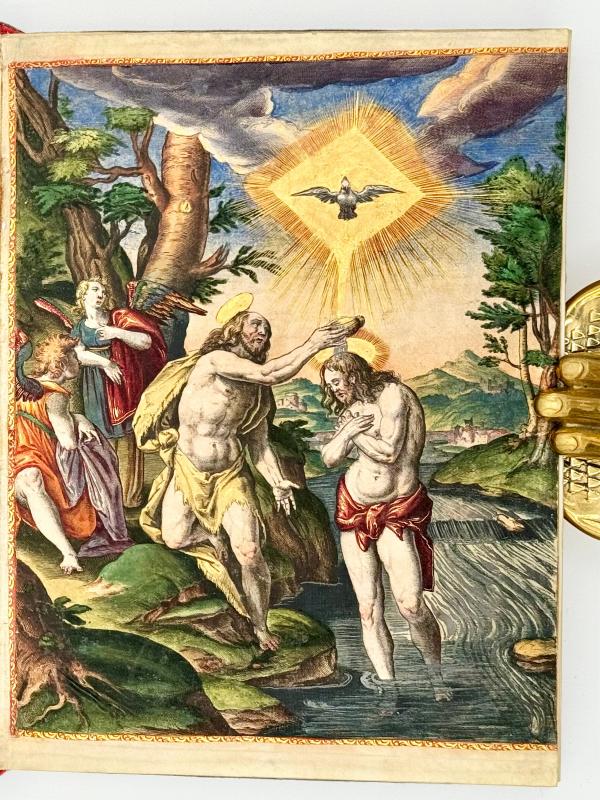
Der christlich Glaube Mit Gottseligen christlichen und hoch tröstlichen Gebeten wie ein jeder Christ Täglich vor den Augen des Herrn seines Gottes erscheinen mag. Nuremberg, ca. 1600. 4to (ca. 212 x 156 mm). German manuscript on vellum. 37 ff.; 1 separate leaf. With 16 mounted full-page engravings, illuminated in gilt and colours, 12 bearing single-line captions in Latin. Modern purple silk binding with floral ornamentation, over wooden boards, on four raised bands. Vellum endpapers. All edges gilt. Stored in felt-lined black half-morocco case with gilt spine title, signed "J. & S. Brockman". Unique prayer book manuscript on vellum, containing sixteen full-page illuminated engravings after Marten de Vos: a highly expressive devotional work of the waning 16th century. One of only eight known manuscripts by Hieronymus Oertl, it provides a "unique example of the art of book arts around 1600" (Baeyer, p. 6), highlighting the transitory period between the Middle Ages and the Baroque, between manuscript and printed book. The twelve engravings illustrate the individual articles of the Creed from Creation to the Resurrection and eternal life. Both content and iconography stand out from Oertl's other efforts: only the "frontispiece" was also used in another of his works (albeit with different illumination). The suite is based on a 13-sheet set of engravings after drawings from de Vos's "Credo", printed in Amsterdam in 1633 as "XII Fidei Apostolicae Symbola". The signature "Ioann Collaert sculp." testifies to the engravers Adrian and Jan Collaert II (while the information "M. de Vos invent." and "Adrian Collaert sculp." or "excud." is trimmed away). The splendid engravings boast gilt highlights and a richly differentiated colour scheme, "ranging from delicate and sensitive translucent washes to pastose coloring" (Baeyer, p. 64). Indeed, Oertl was not only "a fine scribe, but [...] one of the best illuminators of his generation. He was responsible for the selection of the Biblical texts, for writing the prayers, for coloring and gilding the drawings and for illuminating the prints" (ibid., p. 54). On the title-page, Oertl cut out the central medallion, instead inserting his own title inscription to the vellum below. A cartouche proclaims: "All the dead will be resurrected when God's trumpet will sound", and the conclusion reads: "Whosoever departs from this world will be buried in the heavenly fatherland". Written in uniform Gothic script without initials, Oertl structures the prayer text through the size and colour of the letters, the decoration of the headings, and the use of structuring lines composed of pen and ink filigree. A decorative frame in the form of a narrow, gilt red paper border with black rules encloses text and images. The innovative and elaborate combination of old and new makes this illuminated prayer manuscript a precious possession. Three unattributable engravings are included before Oertl's suite of illustrations: a genre scene (Elisabeth and St John as a child visit the stable in Bethlehem), the baptism of the Christ, and - as a frontispiece - the triumphant boy Jesus. An unfinished vellum sheet with the mounted engraving of a crucifix by H. Wierix after de Vos appears to be a later addition; however, Oertl himself used this in two other manuscripts.

Sachgebiete: Handschriften, Illustrierte Bücher, Theologie

02.09.2026 - 12:31

295000,- EUR

Inlibris GmbH