Rare Books Berlin - Internationale Messe für Bücher und Graphik

...

Jean Rodolphe Perronet

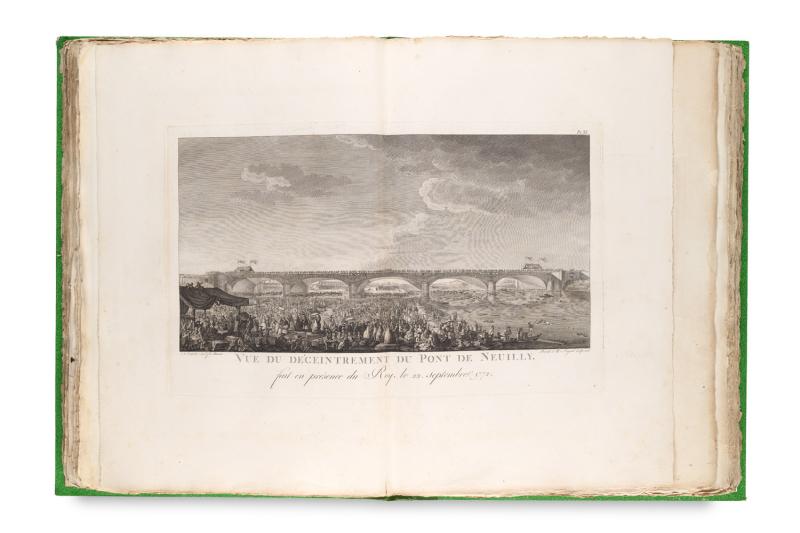
Description des projets et de la construction des ponts de Neuilly, de Mantes, d'Orléans & autres ... 3 Bände (I, II, Suppl.) Mit Porträt des Verfassers als gestochenes Frontispiz (in Bd. I), 2 gestochenen Titeln (wiederholt) mit je großer Vignette (I u. II.) und 82 Tafeln mit Kupferstichen und -radierungen, wovon 36 doppelblattgroß und meist gefaltet. Paris, Imprimerie Royale, 1782, 1783 und Paris, Didot für Jombert, 1789. I. 7 Bll. (Front., Tit., Widm., Vorw., Inhaltsverz.), 112 S., 30 Taf. (num. I-XXX). II. 3 Bll. (Tit., Inhaltsverz.), 154 (recte 156 u. 2, Taf.verz.) S., 38 Taf. (num. XXXI-LXVI, XXXIXbis, Taf. LXIV doppelt) und III. 1 Bl. (Tit.), 59 S., 14 Taf. (num. XXXI-XXXIV, XXXIV*, XXXIV**, XXXV, XLV-XLVII, LXX-LXXIII). Groß-Folio (61 x 45 cm). Spät. Ebde. mit Rücken aus Ldr.-Imitat und goldgepr. Bandnr. u. RTit. (Suppl.) auf montierten Schildern, die Decken mit geädertem Kleisterpapier bezogen (etw. berieben und fleckig). Erste Ausgabe des berühmten Werk über Brückenbauten, hier mit dem seltenen Supplementband und mit überkompletten Tafelsatz. - Bibliotheca Mechanica, S. 249. - DSB X, 528. - Wegweisendes und luxuriös gedrucktes Werk über den Brückbau von Jean Rodolphe Perronet (1708-1794), der hochrangigste Zivilingenieur in den letzten Jahrzehnten des vorrevolutionären Frankreich und persönlicher Architekt von Ludwig XVI. Perronet gründete mit der "École des Ponts et Chaussées" eine der ersten Ingenieurschulen der Welt. - "In the design of bridges Perronet developed the classical stone arch bridge to its ultimate perfection" (DSB). - Die Tafeln und der Text auf voluminösem, festem Bütten mit breiten Rändern und dreiseitigem Schöpfrand. Die detaillierten Zeichnungen von Jean Far Eustache de Saint-Far (1746-1828), einem Schüler des Verfassers, die dieser von der ersten Riege zeitgenössischer Stecher und Radierer, P. L. Auvray, P. G. Berthault, F. Desbruslins, A. Duval, J. F. Germain, J. P. Tardieu, F. N. B. Dequevauvillier, J. de Longueuil u.a. - Taf. XIV verbunden. - Taf. V mit Randläsuren, Taf. XXXI und XXXII in den entsprechend großen Ausschnitt des Originalpapiers montiert. Titelbl. von Bd. 1 mit kl. Erg. zw. Außen- und Fußsteg, die Textblätter von Bd. 1 im Außensteg durchgehend mit schmalem Wasserrand. Papier in den Schöpfrändern stw. mit Lichtrand und angestaubt. Insgesamt solides Exemplar des monumentalen Werks. First edition of the most beautiful work on bridge construction of the 18th ct., our copy with the rare supplementary volume and and an overcomplete set of plates. Profusely illustrated with a portrait of the author as an engraved frontispiece (in vol. I), 2 engraved title pages (repeated), each with a large vignette (I and II) and 82 plates with copperplate engravings and etchings, 36 of which are double-page in size and mostly folded. Bound in later half leather imitation with gilt number and title (supplement) on mounted label, covers in veined paste paper (slightly worn and stained). - For references see above. - A pioneering and luxuriously printed work on bridge construction by Jean Rodolphe Perronet (1708-1794), the most eminent civil engineer in the final decades of pre-revolutionary France and personal architect to Louis XVI. Perronet also founded the 'École des Ponts et Chaussées', one of the world's first engineering schools. - "In the design of bridges, Perronet developed the classical stone arch bridge to its ultimate perfection" (DSB X, 528). - The plates and text are printed on heavy, sturdy mould paper with wide margins and a three-sided deckel-edge. The detailed drawings by Jean Far Eustache de Saint-Far (1746-1828), a pupil of the author, were executed by the foremost contemporary engravers and etchers of the time: P. L. Auvray, P. G. Berthault, F. Desbruslin, A. Duval, J. F. Germain, J. P. Tardieu, F. N. B. Dequevauvillier, J. de Longueuil and others. - Plate XIV bound in wrongly. Plate V with marginal glazes, plates XXXI and XXXII mounted in the correspondingly large sections of the original paper. Title page of vol. 1 with a small repair between the outer and foot margins. The text pages of vol. 1 in the outer margin throughout with a narrow watermark. Paper in the margins and deckle-edges occasionally with with light shelf-wear and dusty. Overall a sound

Sachgebiete: Frankreich, Ingenieurwesen, Technik, Technikgeschichte

03.09.2026 - 12:13

4500,- EUR

Jeschke Jádi Auctions Berlin GmbH

...

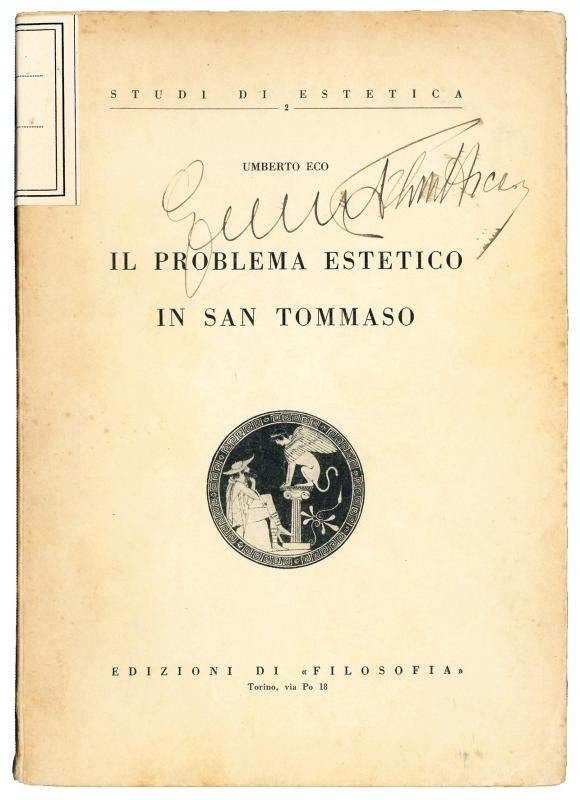
ECO, Umberto (1932-2016). Il problema estetico in San Tommaso. Turin, Edizioni di “Filosofia” (Cuneo, Stabilimento tipografico editoriale “Saste”), 10 August 1956.

4to (250x176 mm). 157, [3] pages. Original publisher’s wrappers. A good copy, uncut and mostly unopened, leaves slightly uniformly browned. Provenance: Giuseppe Flores d’Arcais, considered the founder of the school of personalized pedagogy (his large signature on the front cover and the label of his library on the spine). First edition of the first book by the famous Italian semiotician and novelist Umberto Eco. Il problema estetico in San Tommaso consists of an enlargement of Eco’s thesis developed with the historian and philosopher Luigi Pareyson (1918-1981) on the theme of the complex and original aesthetic theories advanced by the influential medieval thinker Thomas Aquinas (1225-1274). Umberto Eco, a native of Alexandria, graduated in 1954 from the University of Turin with a thesis on St. Thomas Aquinas. After teaching at the Faculty of Letters of the University of Milan, at the Faculty of Architecture in Florence and at the Polytechnic of Milan, in 1975 he was appointed professor of semiotics at the University of Bologna. Eco was awarded many honorary titles by universities from all over the world. Since 1989 he was the president of the International Center for Semiotic and Cognitive Studies and since 1994 of the International Association for Semiotic Studies. Contributor to many Italian newspapers and magazines such as “Il Corriere della Sera”, “La Repubblica” and “L’Espresso”, in his long career and vast bibliography he dealt in particular with aesthetics, artistic avant-garde, linguistics, and mass communication. After the extraordinary success of his debut novel Il nome della rosa (1980), Eco published other works of fiction, among which Foucault’s Pendulum (1988), The Island of the Day Before (1994), Baudolino (2000), and The Prague Cemetery (2010) (cf. P.E. Bondanella, The Cambridge Companion to Umberto Eco, Cambridge, 2013; S.G. Beardsworth & R.E. Auxier, eds., The philosophy of Umberto Eco, Chicago, 2017). Giuseppe Flores d’Arcais (1908-2004) was among the pioneers in the teaching of the history of entertainment and audiovisuals. Graduating from Padua with a degree in musical aesthetics in 1929, Flores d’Arcais, who joined Fascism as a young man, was not only a professor of pedagogy but also of didactics, aesthetics, philosophy, history of theater, of which he held one of the first chairs in Italy (1959-1972), and method and didactics of audiovisual arts until his retirement (1983). He greatly contributed to giving didactic dignity to the disciplines of entertainment, radio communication and cinema, to whose interaction he dedicated his first course “The Problem of Relations between Cinema and Theater”. He gave equal space to the history of theater and cinema, supplementing courses on Luigi Pirandello and the birth of filmaking with sections devoted to the European cinema between 1930 and 1960 or Neorealism. He was a full member of the Accademia Patavina di Scienze, Lettere ed Arti, and a corresponding member of the Istituto Veneto. In addition to his many pedagogical writings, mention should also be made of Il film nella scuola (1963) and Note per una estetica del cinema (in: “Rivista del cinematografo”, 1, 1953, pp. 6-10) (cf. A.M. Bernardinis, Scritti di Giuseppe Flores D’Arcais, in: “Studi in onore di Giuseppe Flores d’Arcais”, Padua, 1985, pp. XXXVII-LXXVII). Considering that Eco and Flores d’Arcais knew each other well and copies of later Eco’s pubblications bearing Eco’s dedication to him are known, it is possible that Eco himself gave this copy to Flores d’Arcais, but did not dedicate it to him as at the time the latter was already a reknown professor while Eco had graduated from university only a few years earlier. L. Gambetti-F. Vezzosi, La letteratura italiana del Novecento. Repertorio delle prime edizioni, Genoa, 1997, p. 188.


03.09.2026 - 11:30

2800,- EUR

Govi Rare Books LLC

...

GRAZIANI, Girolamo (1604-1675). Il Cromuele tragedia del Co: Girolamo Gratiani Segretario, e Consigliere di Stato del Serenissimo Signor Duca di Modona. Bologna, Manolessi, 1671.

4to (190x138 mm). Engraved frontispiece, [14], 160, [2: errata] pp. and [5] engraved folding plates. Collation: [+]4(-+2) ++4 A-V4 χ². Lacking the final (blank?) leaf. Woodcut arms of the dedicatee, King Louis XIV, on the title page. Woodcut initials, head- and tail-pieces. Later boards, red sprinkled edges (joints repaired, slightly rubbed and soiled). Upper outer corner of the half title repaired, lower margin of the title page trimmed with loss of a line of text, some foxing, marginal tears to some of the plates skilfully repaired, tiny portion of a plate missing, all in all a good copy. Rare first illustrated edition, also printed in the same here without illustrations in Modena by Soliani and reprinted in Bologna by Manolessi in 1673, of this five-act tragedy by Count Girolamo Graziani, a man of letters from Modena who served as secretary and advisor to the Duke of Modena. The play, conceived in the 1660s during Laura Martinozzi’s regency in Modena, depicts the dramatic events of the English Civil War, pitting the tyrant Oliver Cromwell against the martyr Charles I. Inspired by the typically seventeenth-century tendency to rewrite recent historical events for political purposes, the play paints a hagiographic portrait of the English monarch, whose blood comes to take on a strong symbolic and almost Christ-like significance following his death sentence (cf. P. Di Nepi, Girolamo Graziani e la politica come arte: “Cromuele”, in: “F.M. Annali dell’Istituto di Filologia Moderna dell’Università di Roma”, 2-1979, Rome, 1981, pagg. 113-24). From the very beginning, the tragedy presents itself as a Baroque device in the service of defending the monarchy, through a pseudo-historical - yet theatrical - reconstruction of the events of 1649. It is true that the tragedy makes use of specific historical references, but - as is usually the case in seventeenth-century theater - these are condensed into a single night, that of January 30, 1649 (cf. S. Miglierina, Il sangue di Carlo: apologia e licenza teatrale nel Cromvele di Girolamo Graziani, in: “Krypton”, vol. 1, 2013, p. 47). The first mention of the tragedy’s composition appears in the preface to Girolamo Graziani’s Varie Poesie e Prose (1662). Beginning in 1666, the composition of the Cromuele was accompanied by an extensive correspondence with Jean Chapelain, with whom Graziani - who was on the payroll of Colbert on behalf of the Sun King - corresponded regularly (cf. R. Galli Pellegrini, La Tragédie Italienne à l’école du classicisme Français: le rôle de Chapelain dans la genèse du “Cromuele” de Graziani, in: “Quaderni del Dipartimento di Lingue e Letterature Straniere Moderne, Università di Genova”, 2-1987, pp. 35-57). There is no mention of a performance of Il Cromuele in the preface to the second edition of 1673, nor is there any trace of it in the extensive documentation on theatrical performances in the Este States preserved in the State Archives of Modena. The likely reason for the play’s failure to be staged was the dynastic marriage that took place in 1673 (just two years after the 1671 publication) between Maria Beatrice d’Este and Giacomo Stuart, who had been widowed in the very year of Il Cromuele’s publication by Anna Hyde - the woman with whom he appears to be in love in the tragedy. This was an inconvenient presence for Graziani, who, as secretary of state, had looked after the Este family’s interests in that marriage (cf. M. Fasce, Introduzione e note alle edizioni de Il Cromuele, in: “Storie Inglesi, l’Inghilterra vista dall’Italia tra storia e romanzo XVIII sec.”, C. Carminati-S. Villani, Pisa, 2011, pp. 297-330). Girolamo Graziani, who earned a degree in law and humanities in Bologna, served as an advisor and secretary to the princes, that is, to the sons of Alfonso III of Modena. After several legal disputes, he traveled in 1648 on a diplomatic mission to Paris, where he witnessed the Fronde, before returning to Modena in 1649, where he continued his diplomatic and literary career. Graziani was in Paris, at the French court, at the time of the execution of the King of England, and this suggests that he was a direct witness of the scandal that the event could have caused at the court of the nephew of the murdered king. Graziani decided to recount those events in a dramatized version twenty-two years after Charles’s death, thirteen after Cromwell’s, and eleven after the restoration of the monarchy in England (cf. F. Tarzia, Graziani, Girolamo, in: “Dizionario Biografico degli Italiani”, vol. 58, Rome, 2002, s.v.). Italian Union Catalogue, IT\ICCU\CFIE\004848; Clubb, 483; Brunet, II, 1719.


03.09.2026 - 11:28

5500,- EUR

Govi Rare Books LLC
...

BERNI, Francesco (1610-1673)]. Il torneo a piedi, e l’invenzione, ed allegoria, colla quale il Signor Borso Bonacossi comparì a mantenerlo: e l’Alcina maga favola pescatoria [...] Ferrara, Gioseffo Gironi & Francesco Gherardi, 1631.

4to (198x140 mm). [16], 107, [1] pp. and [6] etched folding plates attributed to Alfonso Chenda (1607-1640). Collation: a-b4 A-M4 N6. 18th-century half vellum, inked title on spine, panels covered by light blue floral paper, red sprinkled edges (slightly worn and rubbed). Private stamp to the title-page verso. Worm track to the lower outer corner of the first ten leaves, which then becomes just a small hole, never affecting the text, other work track to the outer margin of the final leaves with no loss of text, two small holes on l. C2 one of which slightly affects the text, some foxing and staining, more strongly towards the end, all in all a good, genuine copy. Extremely rare first and only edition of the account by Francesco Berni (1610-1673, disguised under the academic name of “Aggirato”) of the first festival held in Ferrara after the War of the Mantua Succession (1628-1631), to celebrate the wedding of Giovanni Francesco Sacchetti (1595-1656) and Beatrice Estense Tassoni (1611-1633), in the presence of the Duke of Mantua, Charles de Nevers -to whom the volume is dedicated- and Cardinal Giulio Sacchetti. The book describes a tournament organised by Borso Bonacossi at Carnival time and accompanied by recited texts (one of which is signed by Ottavio Magnanini), as well as poems, stage designs, and machinery (pp. 6-86). It also contains the Alcina maga, a “favola pescatoria” by Sebastiano Martini (pp. 87-96), a wedding ode by Francesco Berni recited that same evening (Il Tebro, overo la Pittura loquace del pittor muto, pp. 99-107), two sonnets, by Alfonso Fiornovelli and Ippolito Visdomini, and a Latin poem by I. Visdomini. The plates depict the allegorical and historical re-enactments that were performed, including two scenes from the Alcina maga. Sartori, 23349; Italian Union Catalogue, IT\ICCU\MODE\034506; Michel & Michel, I, pp. 152-153; Watanabe, 418; Cicognara, 1438.


03.09.2026 - 11:24

12000,- EUR

Govi Rare Books LLC

...

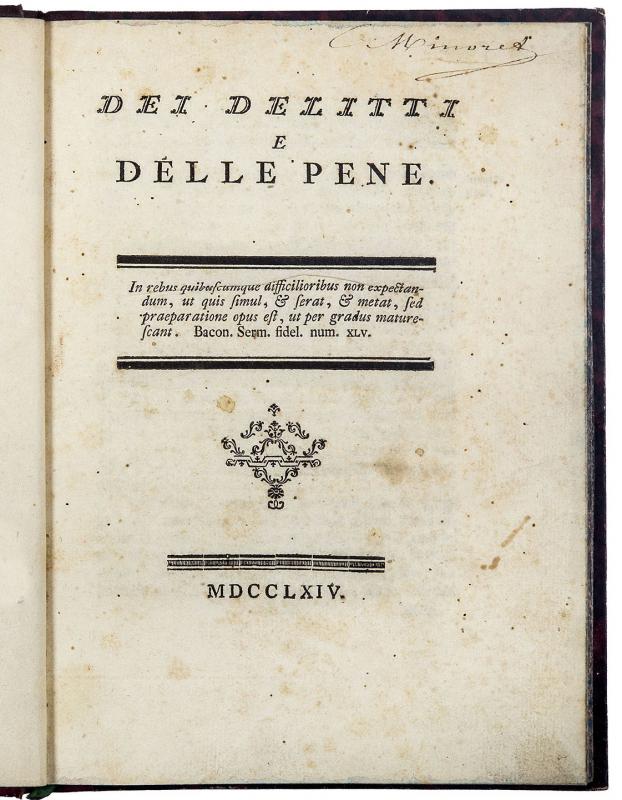
[BECCARIA, Cesare (1738-1794)]. Dei delitti e delle pene. N.pl., n.pr., n.d. [Livorno, Marco Coltellini], [July] 1764.

4to (203x145 mm). 104, [2] pp. Collation: A-N4 χ1. 19th-century French half morocco, spine with four raised bands and gilt title, marbled endleaves and marbled edges. Between the front flyleaves is a loose paper strip written in an elegant 19th-century hand which contains a few verses against torture taken from Voltaire’s Ode à la verité. On the title page is the ownership entry “C. Minoret”. Title page a bit soiled, uniformly slightly browned, some scattered foxing, all in all a good, wide-margined copy. First edition (in one of the rare copies with the errata leaf containing twenty-one corrections, printed as a separate sheet) of one of the most important works of the Italian Enlightenment. A manifesto on legal reform, and one of the best interpretations of the ideas circulating around France in the second half of the eighteenth century.
The young Milanese nobleman Cesare Beccaria Bonesana composed this work between March 1763 and January 1764, while he was an active member of the intellectual circle known as the Accademia dei pugni, founded in Milan in 1762 by the brothers Alessandro and Pietro Verri, and Beccaria himself, among others. The central theme of the work is the reform of criminal justice, in a context in which punishment was still both brutal and arbitrary. Beccaria advocates an egalitarian justice system and traces a new metric for punishment and laws rooted in the concept of public happiness. “One of the most influential books in the whole history of criminology [...] Beccaria maintained that the gravity of the crime should be measured by its injury to society and that the penalties should be related to this. The prevention of the crime he held to be of greater importance than its punishment [...] his ideas have now become so commonplace that it is difficult to appreciate their revolutionary impact at the time” (PMM). The work enjoyed wide and immediate success, and its influence was enormous. Voltaire, d’Alembert, Helvétius, Holbach, Hume, and Hegel all counted among its enthusiastic readers; Beccaria’s ideas also inspired justice reforms introduced by Grand Duke Leopold of Tuscany, Emperor Joseph II, and Catherine II of Russia, and its influence on constitutionalism broadly, especially the Declarations des droits de l’homme of 1789, is likewise evident. The Dei delitti e delle pene was published in Livorno (Tuscany) – then one of the most advanced cities in Italy – on 12 April 1764, anonymous and without indication of place, for fear of repercussions owing to its strong egalitarianism. The printer Coltellini had already published, in 1763, the Meditazioni sulla felicità by Pietro Verri, Beccaria’s closest friend. The ‘innovative’ feature of the reform proposed by Beccaria was, however, perceived by the Roman censorship, and in 1766 Dei delitti e delle pene was included in the Index of Forbidden Books. A good sign, as Beccaria admonishes: if a government needs censorship, it comes from the weakness of its constitution. The work was translated into English in 1767, and On Crimes and Punishments “significantly shaped the views of American revolutionaries and lawmakers. The first four U.S. Presidents – George Washington, John Adams, Thomas Jefferson and James Madison – were inspired by Beccaria’s treatise and, in some cases, read it in the original Italian. On Crimes and Punishments helped to catalyze the American Revolution, and Beccaria’s anti-death penalty views materially shaped American thought on capital punishment, torture and cruelty” (J. D. Bessler, The Italian Enlightenment and the American Revolution, p. 1). Gamba, no. 2147; Parenti, p. 67; Melzi, I, p. 281; Printing and the Mind of Man, no. 209; L. Firpo Le edizioni italiane dei delitti e delle pene, Milano, 1984, no. 1; Einaudi, no. 3362; B. E. Harcourt, Beccaria’s ‘On Crimes and Punishments’: A Mirror on the History of the Foundations of Modern Criminal Law, Chicago, 2013; M. Palumbo & E. Sidoli (eds.), The Books that Made Europe, Bruxelles, 2106, pp. 248-249.


03.09.2026 - 11:21

18000,- EUR

Govi Rare Books LLC