Tavares de Velles Guerreiro, João, active 1718
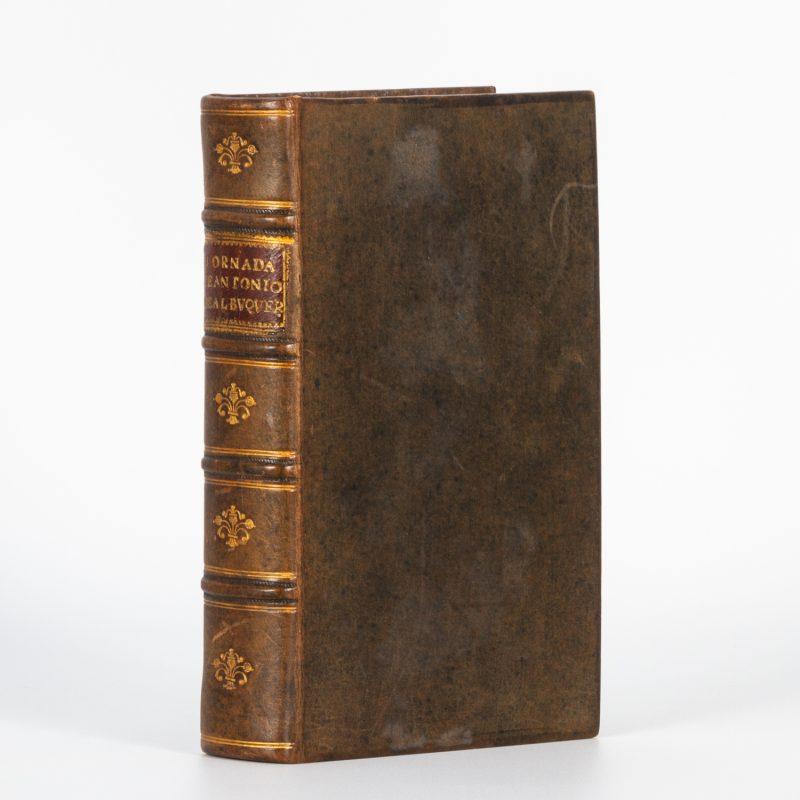
Jornada, que o senhor Antonio de Albuquerque Coelho, Governador, e Capitão General da Cidade do Nome de Deos de Macao na China, fez de Goa atè chegar á dita Cidade no anno de 1718. Dividida em duas partes. Escrita pelo Capitão João Tavares de Vellez Guerreiro, e dedicada a o Duque ... ... Lisboa Occidental : Na Officina da Musica, por D. Jayme de la Te y Sagau, 1732. Octavo, full calf binding by Aquarius. spine in compartments with gilt decoration and contrasting label lettered in gilt; title with the early ownership inscription of Antonio Caetano da Silva, and a (?nineteenth-century) wet stamp with a monogram surmounted by a crown; pp. [16], 427, [1 blank]; all text set within double-ruled black borders; woodcut initials, head- and tailpieces; very occasional handling marks to margins, last few leaves with some marginal worming, but overall a clean, crisp copy.
Scarce second edition of this first-hand account by Tavares de Velles Guerreiro of the gruelling year-long voyage of António de Albuquerque Coelho (1682-1745) from Goa to the "City of the Name of God" - Macau - after he had been deliberately stranded in Goa. Albuquerque Coelho served as Governor of Macau from 1718-1719 and later as Governor of Timor. Tavares was Albuquerque's aide-de-campe and made the voyage with his superior from Goa that commenced in May 1717 and included an eventful six-month sojourn at Johore, during which Albuquerque became a participant in a coup-d'etat by the Sumatran Raja Kecil.
The first edition, printed in Macao in 1718, was the only secular work printed by the Jesuits in China and one of the last xylographic printings they produced there. This second edition is a reprint of the extremely rare first, and is dedicated to the Duke of Cadaval by its printer and publisher, Jaime (Jayme) de la Te y Sagau.
Cordier, Sinica, 2319; Howgego, A47; Löwendahl, 377
Sachgebiete: Asien, China, Reisen/Reiseliteratur
10.09.2026 - 10:02
4500,- EUR
Douglas Stewart Fine Books (Australia)