Rare Books Berlin - Internationale Messe für Bücher und Graphik

...

STIEGLITZ, Alfred.

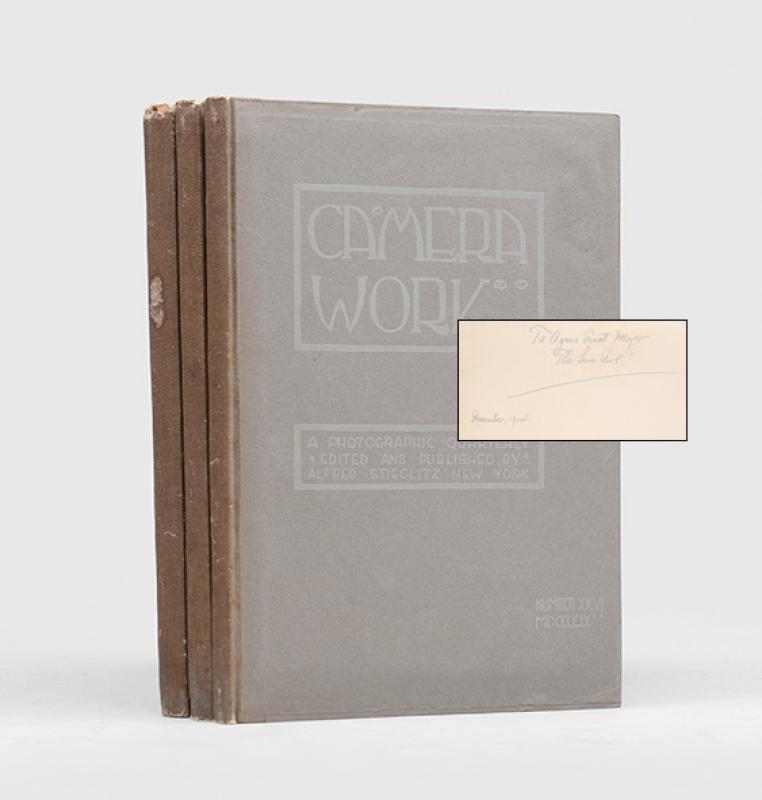
Camera Work. Nos. 1, 25, & 26. 1903 & 1909. ¶ Three vols, tall quarto. With 24 hand-pulled photogravures and 1 photogravure (not hand-pulled). Bound for presentation in grey quarter cloth, preserving original wrappers pasted onto grey paper-covered sides. Edges worn, faint foxing and offsetting to a few leaves, more so to No. 1, slight loss at head of spine of No. 1, neat paper repair to front cover: a near-fine set. A full description is available on request. ¶ Three issues of the seminal photography periodical, including the inaugural issue, each a presentation copy inscribed by Stieglitz to his friend and collaborator, the philanthropist and civil rights activist Agnes E. Meyer. ¶ Camera Work was a quarterly publication that circulated work by some of the world’s most important photographers. Stieglitz showcased photography as a fine art and his journal has been called “by far the most beautiful of all photographic magazines” (Whelan). These issues contain 25 photogravures, primarily by members of the Photo-Secession movement. Photographers represented here include founder-members Gertrude Käsebier and Frank Eugene, the iconoclast Anne W. Brigman, and the distinguished portrait photographer Alice Boughton. Meyer was an activist and patron of the arts. One of the first woman journalists hired by the New York Sun, Meyer was nicknamed the “The Sun Girl” in Stieglitz’s artistic circle. She was one of his “she Graces”, together with the artists Katharine Rhoades and Marion Beckett. Together, she and Stieglitz created and published the art magazine 291 between 1915 and 1916, notable for its printing of the earliest example of visual poetry in America - written by Meyer. Her marriage to the financier Eugene Meyer allowed her the wealth and freedom to advocate for social causes. She influenced national policy by lobbying for the creation of the Department of Health, Education, and Welfare, and her husband’s ownership of the Washington Post gave her a platform to criticize Nixon, campaign against racial inequality, and lampoon McCarthyism as a threat to liberty. Issue I is inscribed on the front free endpaper, “To Agnes Ernst Mayer, ‘The Sun Girl’, December, 1914”; No. XXV is inscribed on the first blank, “To Agnes E Ernst, with cordial greetings and best wishes, AS. NY, Dec 21/[illegible, perhaps 08]”; No. XXVI is inscribed on the first blank, “With kindest regards, cordially, AS. To Agnes Ernst. Paris. March 10 - 1909”. ¶ Richard Whelan, Alfred Stieglitz: A Biography, 1995.

Sachgebiete: Photographie

28.07.2026 - 23:05

40000,- EUR

Peter Harrington

...

ROME GUIDEBOOK.

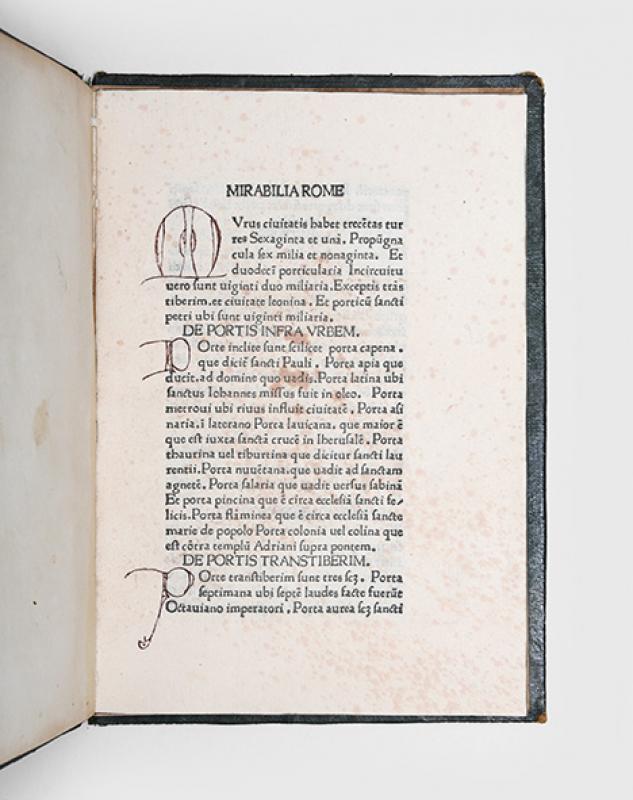
Mirabilia Romae. [Sant’Orso: Giovanni de Reno, c.1475]. ¶ Quarto (195 x 138 mm): [a8]; 8 leaves, unnumbered. Roman type 97R, 28 lines per page. Watermark: scale in a circle. Mid 19th-century green morocco, elaborate gilt and blind floral frames to covers, gilt monogram “AF” and crest of the Duke of Genoa and Prince of Savoy Ferdinando Alberto di Savoia-Carignano (1822-1855) in center of front and rear covers respectively, board edges tooled in gilt, pink endpapers, edges gilt. Housed in a custom green cloth solander box. Professionally recased and refurbished, including discreet repair at spine ends, one corner, and the gilt retouched, peripheral browning to endpapers from binder’s paste, contents lightly foxed. A very good copy, attractively bound. ¶ A rare incunable edition of the earliest European printed guidebook, a geographically arranged inventory of the “unmissable” monuments and sites of Rome. This copy was handsomely bound in green morocco for the library of Prince Ferdinando of Savoy, first duke of Genoa, with his coat of arms and initials in gilt on the covers. Dubbed by PMM the “Renaissance Baedecker”, Mirabilia Romae (“The marvels of Rome”) was composed about 1140-50 by an anonymous writer - sometimes identified as Benedict, Canon of St Peter’s - as a guide for the pilgrims to the city. First printed in the early 1470s, it was reprinted multiple times over the following century, and translated into Italian, English, Spanish, and German. The great popularity of this work during the Renaissance illustrates a new awareness of the significance of ancient Roman remains and “was instrumental in preserving some of them. The Memorabilia is a valuable source for our knowledge of what remained and attracted notice in medieval Rome. One of its pleasant side-effects was the beginning of measures for the ‘protection of ancient monuments’ - such as Trajan’s column - as the Roman authorities realized their importance for tourism” (PMM). “The author of the Mirabilia concentrates attention on ancient Rome; churches serve only to locate the presumed site of an ancient building or sanctuary. Thus he leads a systematic tour through the ancient city, always focusing on the monuments; their identification from literary references, though important, is secondary. Starting at the Vatican, he lists the obelisk - its globe contains, as [the author] is the first to say, Caesar’s ashes; the two mausolea - one presumed to be a temple of Apollo; and the pigna and its canopy in the atrium. Thence he moves to the Mausoleum of Hadrian and other ancient monuments nearby; across the river to the Mausoleum of Augustus, the Pantheon, and the other temples of the Campus Martius; and as the climax, to the Capitol and its long-lost temples, to the Forum and the Palatine. A tour of ancient monuments... terminates the survey” (Krautheimer, p. 199). This is one of the earliest known editions. ISTC lists eight editions conjecturally printed in the 1470s, of which all except the edition printed at Treviso by Gerardus de Lisa, de Flandria, 12 April 1475, is without a specified date or place. All are exceedingly rare, and only two of the eight editions have appeared in commerce in modern times. A copy of this edition and a copy of the Treviso edition were lots 282 and 283 in the Kissner sale at Christies London, October 1990, and another copy of this edition was offered at Sotheby’s London in 2011. ISTC counts 13 holding institutions of this edition. This edition is assigned to the printer Giovanni de Reno, active in Sant’Orso (Valle d’Aosta, Italy), based on the type and watermark. “This edition, like that of De Lisa, Treviso, 12 April, 1475, has at the end a chapter concerning ‘Totilae exasperatio in servos Dei’. The chapter headings are at first printed in capitals, as in De Lisa’s edition, but revert to minuscules on 2b. While it thus appears to be certainly a reprint of De Lisa’s work and while the watermarks link it with Sant’Orso, the 9 (upper case) is throughout set at the medium height characteristic of De Reno’s work in 1473. Probably it is an early production at Sant’Orso, printed with a remainder of old type” (BMC VII 1027). Provenance: a) Prince Ferdinando Maria Alberto of Savoy (1822-1855), son of the King of Sardinia Carlo Alberto and founder of the Genoa branch of the House of Savoy. He owned a substantial library, mostly focused on military books. In addition to the supralibros, this copy has the prince’s ownership label lettered “Biblioteca di S[ua]. A[ltezza]. R[eale] Il Duca di Genova” and a shelf-label “C. II-32” on the front pastedown; his library stamp (faded) on the rear free endpaper. b) Early 20th-century bookplate of a member of the Asinari di Rossillon family of Bernezzo, likely Giuseppe Mario (1878-1943), marquis of Bernezzo, with his bookplate on the front free endpaper verso; he was army general and first aide-de-camp to King Emanuele II. ¶ BMC VII.1027; Goff Suppl. M591a; GW M23540; ISTC im00590600. Richard Krautheimer, Rome: Profile of a City, 2000.

Sachgebiete: Einbände, Inkunabeln, Italien, Reisen/Reiseliteratur, Reiseführer

28.07.2026 - 23:02

72000,- EUR

Peter Harrington
...

OTSUKI, Gentaku.

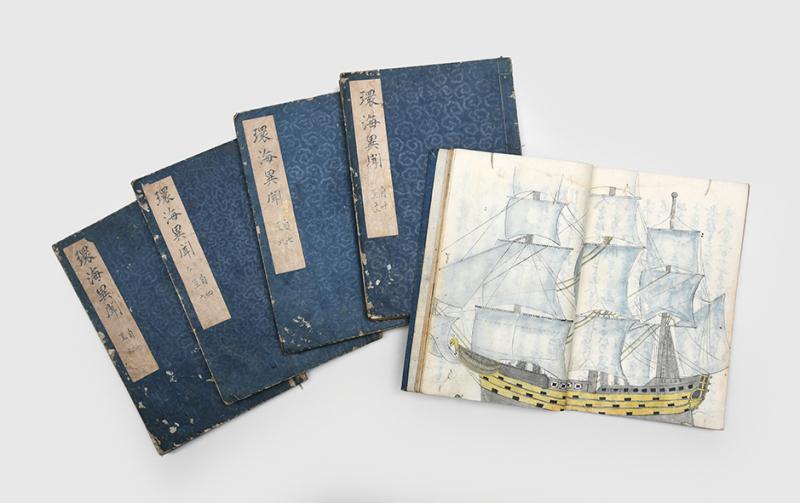
Kankai ibun (“Strange Tales of a Circumnavigation”). [Japan: 1807-19]. ¶ 14 parts in 5 vols, large octavo, manuscript on recto and verso of each leaf. With 82 manuscript drawings (63 hand-coloured, 1 loosely inserted), 2 manuscript maps (1 hand-coloured); text in classical Japanese. Original blue cloud-patterned wrappers, renewed grey thread fukuro-toji binding, manuscript title labels on front wrappers. Contemporary inscription of one Mr Naito, Buheicho, Nagoya, on final page of each vol., later manuscript catalogue note loosely inserted. Wrappers worn and creased, thread loose in places but stable, occasional worm-holing and tidemarks internally: a very good example. An early manuscript copy, recounting the travels of four Japanese sailors shipwrecked in Russia and their return to Japan aboard Krusenstern’s voyage. Besides a map tracing the route, it contains many accomplished illustrations, including a portrait of two indigenous Hawai’ians, a depiction of a Russian planetarium, and many diagrams of Western clothes. ¶ In late 1793, the vessel Wakamiya-maru set sail for Edo, but storms drove it off course to the Aleutian Islands. After months, the crew were discovered and taken to Russia, where they remained for the next decade. In 1803, Tsar Alexander I asked the 10 surviving crewmen whether they wished to return to Japan aboard Krusenstern and Rezanov’s famous circumnavigation. Four agreed - Tsudayu, Gihee, Sahei, and Tajuro - who were accompanied by a fifth, Zenroku, working as Rezanov’s interpreter. They arrived in Nagasaki in 1804, becoming the first Japanese people to travel around the world. They were interrogated by the scholar Otsuki Gentaku, whose write-up of the interviews, Kankai ibun, circulated in manuscript in 16 volumes from 1807. Their story captured great attention at a time when it was still punishable by death for Japanese people to leave the country and accounts of the outside world were scarce. There is much attention paid to the technology and culture they saw in Russia, as well as their experiences in Britain, Brazil, the Canary Islands, and Hawai’i. The red ownership stamp of the poet Shimosato Denpo (1762-1819) dates this copy to the early 19th century. Textually it matches the Waseda University Otsuki-bon copy. The scribe omits the preface volume and Volume 14, although he includes the world map from the preface in Volume 1. The illustrations generally match those identified by the historian, linguistics researcher, and bibliographer of Kankai ibun, Sugimoto Tsutomu.

Sachgebiete: Asien, Buchmalerei, Japan, Russland, Reisen/Reiseliteratur

28.07.2026 - 22:47

21000,- EUR

Peter Harrington

...

LANG, Fritz (dir.).

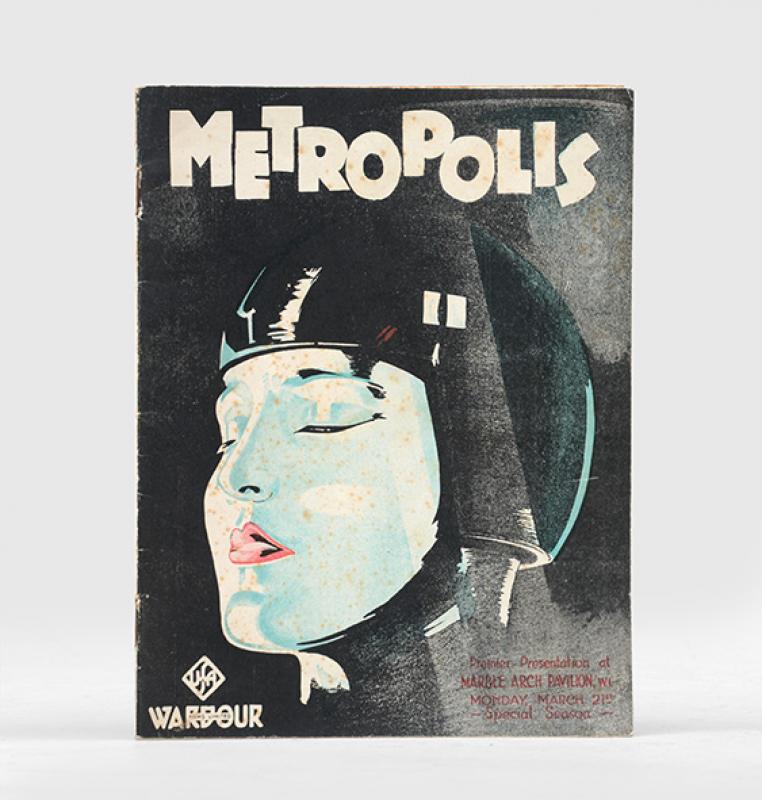
Metropolis: Premier Presentation at Marble Arch Pavilion, W.1. Monday, March 21st. Special Season. [Titlepage:] “Metropolis” Magazine. Depicting Scenes, Story and Incidents in the Making of the World’s Greatest Modern Spectacular Film Masterpiece... London: Wardour Films Limited, 21 March 1927. ¶ Quarto (248 x 189 mm). Single quire, wire stitched, pp. 32. Original pictorial wrappers, monochrome lithograph with blue and red colouring. Many photographic illustrations, portraits and stills from the film. Slight rusting to staples, light foxing to covers, otherwise in very good condition. ¶ Striking souvenir programme for the British premiere of Lang’s masterpiece. Included among statements by the producer, cast and principal crew are some marvellous descriptions and scenes from the making of the film. A full synopsis is given and a particularly interesting section, entitled “Death to the Machines! These pages show how Thea von Harbou constructed the scenario of ‘Metropolis’ from the lines of her novel”, illustrates in parallel text how passages of film were adapted from the fictional source. Metropolis had its premiere at the Ufa-Palast am Zoo in Berlin on 10 January 1927. The arresting cover image - depicting Maria in the headpiece that transfers her animus to her robotic double - is taken directly from the original German poster artwork by Kurt Degen, a leading designer who created posters for Murnau’s Nosferatu (1922), Frankenstein, and M (both 1931). Decidedly scarce: very few copies appear in commerce.

Sachgebiete: Film, Science fiction, Großbritannien

28.07.2026 - 20:18

6000,- EUR

Peter Harrington

...

KLEE, Paul.

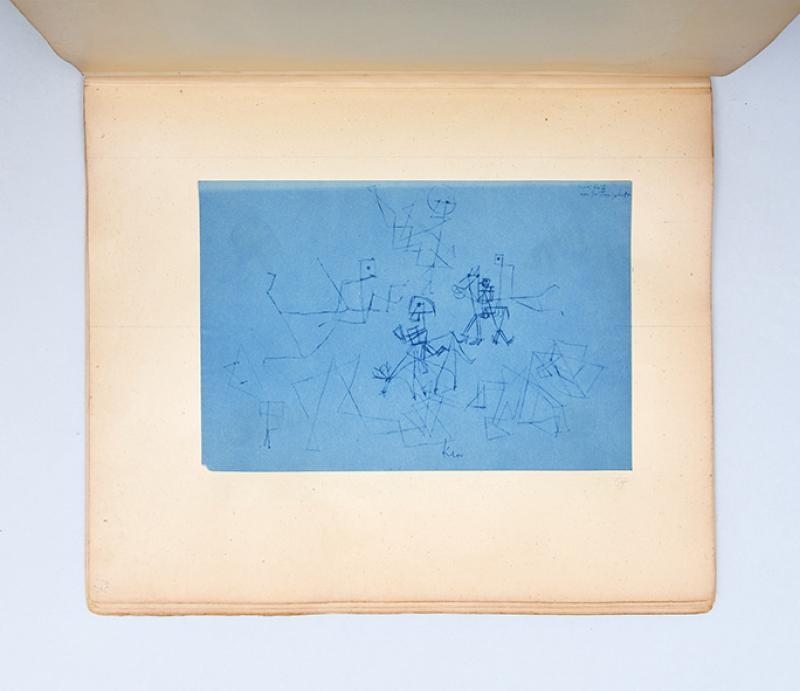
Maquette for Handzeichnungen 1921-1930. Düsseldorf: 1934. ¶ Maquette: Quarto. Original hand-bound black card covers (28.1 x 24.2 cm). With 69 cyanotypes of different sizes mounted on card after original drawings by Klee. Book: Quarto. Original yellow boards, spine and front cover lettered in black, illustration after Klee on front cover in black. With 72 full-page illustrations after original drawings printed on heavy card with perforation to the inner margin. Housed in a black cloth flat-back box by the Chelsea Bindery. Maquette: covers and most pages disbound with small loss to corners and edges, lacking pages 16, 26, and 27. Book: small loss to joints of spine, otherwise clean and bright, a very good copy. ¶ Original maquette for the first volume of Klee's Handzeichnungen, accompanied by a first edition of the book, number 33 of 525 copies. Most of the edition was later confiscated by the Nazis. The maquette is signed by the art critic Will Grohmann, author of the introduction, and both maquette and book were owned by two expressionist dancers associated with the 1936 Berlin Olympics. ¶ Grohmann planned a three-volume catalogue raisonné of Klee’s work, despite mounting criticism from the Nazi Party. In 1933 Klee was dismissed from his teaching post in Düsseldorf and fled to Switzerland. The first volume appeared in October 1934; by spring 1935 the remaining copies were seized by Nazi officials, and Grohmann was forced to suspend publication of the projected second and third volumes. In 1937 Klee’s work was included in the Nazi exhibition of so-called “degenerate art”. The first edition bears the ownership inscription of the dancer and choreographer Mary Wigman, together with a presentation inscription in Grohmann’s hand: “Mary Wigman, Im Alter treu ist Freundschaft ("loyal friendship in old age"), 13 Nov. 1934”. Wigman was a pioneering figure of expressionist dance and a cultural icon of Weimar Germany. She later collaborated with the Nazi regime, accepting a commission for the 1936 Olympics; although privately sympathetic to Jewish students, she complied with orders to dismiss Jewish dancers from her company. The maquette was presented to the dancer Mathilde Thiele (b. 1907), who typed Grohmann’s introduction. Thiele studied under Gret Palucca, later taught Dore Hoyer, and in the 1960s joined the staff of Wigman’s school. When Palucca was summoned to dance for Hitler at the 1936 Olympics, Thiele accompanied her as rehearsal director. Thiele later recalled the dinner with Hitler, noting the mortal danger had Palucca’s Jewish background been known. "After dinner, Palucca and I were so relieved we drank a whole bottle of wine in our room. We considered that Herr Goering might help Palucca escape if needed. We had word that he helped artists (even Jews) through an underground operation, despite his close relationship to Hitler" (Fraleigh). ¶ Grohmann 2226 & others. Sondra Fraleigh, “Mathilde Thiele, A Life in Dance and War”, 2021.

Sachgebiete: Handzeichnungen, Deutschland, Moderne Kunst, Politik, Weltkrieg

28.07.2026 - 20:11

60000,- EUR

Peter Harrington

...

KEATS, John.

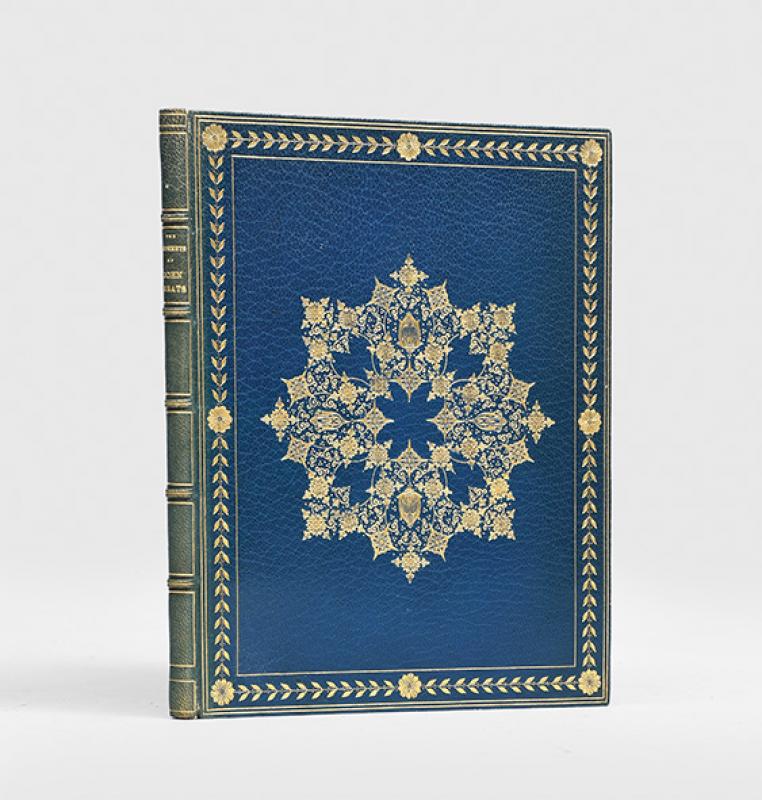
Sonnets. [c.1900]. ¶ Quarto (215 x 175 mm). Title within wood-engraved border, wood-engraved initials throughout. Contemporary bright blue crushed morocco, spine lettered in gilt, compartments framed with single gilt fillet, boards with double gilt fillet enclosing broad border of leafy stems interspersed with floral tool, framing large central flower-shaped medallions elaborately tooled with two different lozenge tools, two stylized bulb tools, and fine single dot curlicues, gilt-ruled turn-ins with floral tool and single dot details at corners, top edges gilt, fore and bottom edges uncut. Spine sunned, flyleaves toned from turn-ins, a couple of spots of foxing to edges, still a fine copy. ¶ A consummate example of British provincial fine binding: this elegantly printed selection of Keats’s verse was bound by the renowned Staffordshire firm of Bagguley. The bindery employed some of the generation’s best finishers; the quality of their work is clear here from the filigree-like medallions, carefully built up with many different tools. ¶ The bookseller George Thomas Bagguley (b.1860) established himself in Newcastle-under-Lyme in 1890. Some of the top finishers in Britain moved from urban centres to practise in the bindery arm of the business, which, unusually, hired external designers. It flourished briefly but spectacularly around the turn of the century. “Quite how a small market-town... could support a bindery producing a work of this quality is not clear” but, as it was, Bagguley bindings featured in some of the 20th century’s finest collections (The Wormsley Library catalogue, p. 87). This binding has the bookplates of W. A. Foyle (1885-1963), the founder of the famous Charing Cross Road bookshop, and the distinguished bookseller and collector Robin de Beaumont (1926-2023). The volume bears no imprint or date, but the endpapers are watermarked 1900. We have traced another copy of this edition in a Bagguley binding. ¶ The Wormsley Library: a personal selection by Sir Paul Getty, Catalogue of an exhibition held at The Pierpont Morgan Library, New York, 27 January - 2 May 1999.

Sachgebiete: Einbände, Literatur bis ca. 1900, Großbritannien

28.07.2026 - 20:07

5700,- EUR

Peter Harrington

...

KAZANTZAKIS, Nikos.

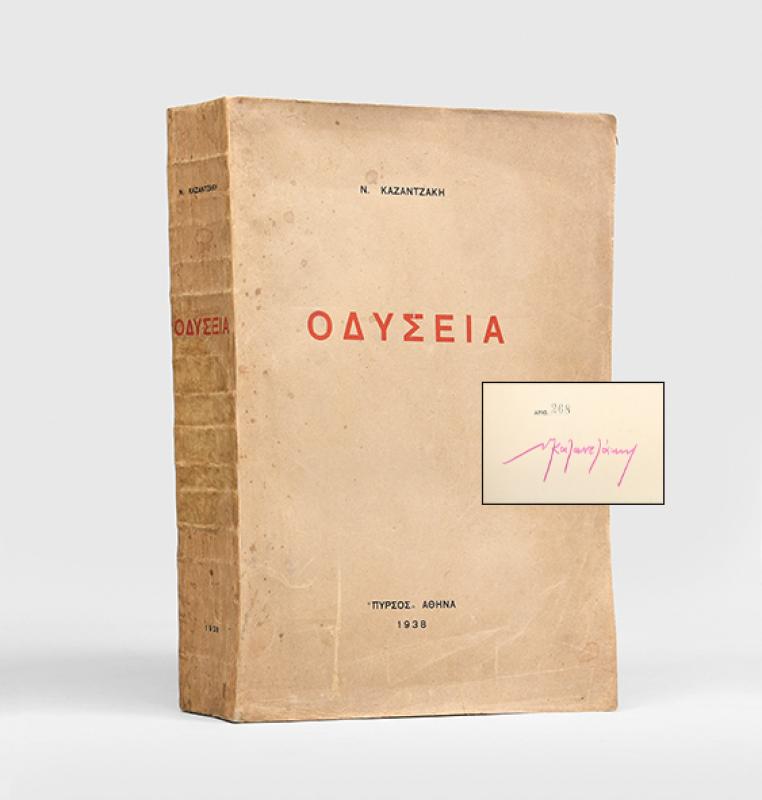
Odyseia. Athens: Pyrsos, 1938. ¶ Folio. Original buff wrappers, spine and front cover lettered in red and black, gatherings unopened. Spine and extremities restored, with a couple of letters retouched, a little spotting and marks on sides, slight foxing to edges, small hole at foot of initial blank. A very good copy. ¶ First edition, number 268 of 277 copies numbered in Roman numerals and signed by the author, from a total edition of 301 copies. Kazantzakis’s major work is an ambitious sequel to Homer’s Odyssey and one of the “very first monuments of European Modernism” (Gonzáles-Vaquerizo, p. 104). This is the only copy in wrappers that we have traced on the market and in auction records. Kazantzakis (1883-1957) began writing Odyseia in 1924, during a period of intense personal turmoil after he returned to his native island of Crete. The poem is deeply autobiographical, with many characters inspired by people he met in real life. It was published after fourteen years of revisions and seven rewritings. The text mirrors the structure of Homer’s Odyssey, divided into 24 rhapsodies, but is roughly twice as long and employs an experimental style marked by abundant neologisms and intricate syntax. The plot follows Odysseus after his return to Ithaca: restless in domestic life and driven by an insatiable desire for freedom, he embarks on a series of new journeys culminating in his arrival in Antarctica. ¶ Helena Gonzáles-Vaquerizo, “Kazantzakis Odyssey as a Cretan and Modernist Masterpiece”, in Liana Giannakopoulou & E. Kostas Skordyles, eds, Culture and Society in Crete, From Kornaros to Kazantzakis, 2017.

Sachgebiete: Griechenland, Literatur ab ca. 1900

28.07.2026 - 20:03

11500,- EUR

Peter Harrington