Rare Books Berlin - Internationale Messe für Bücher und Graphik

...

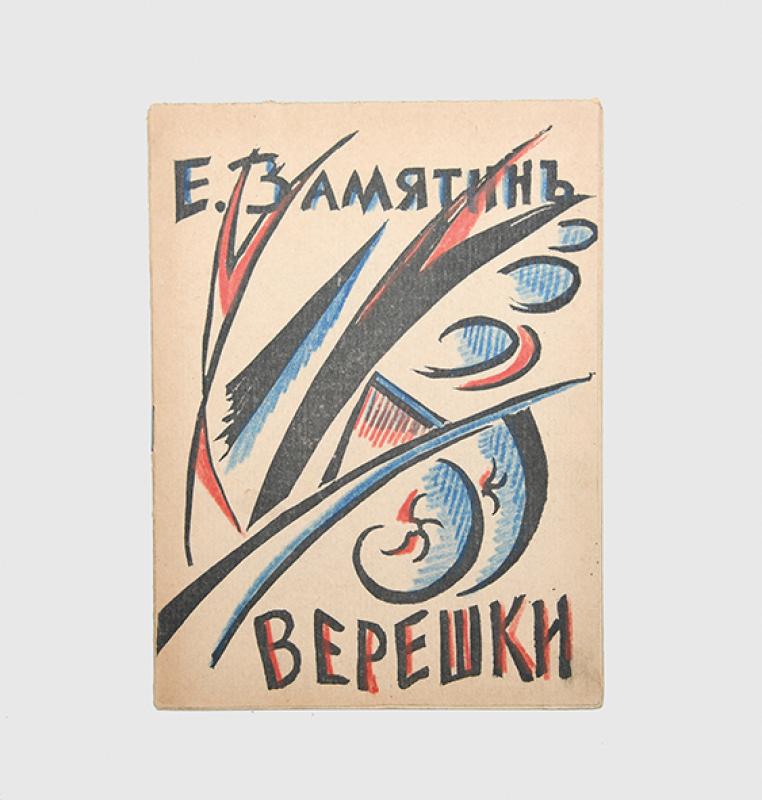
ZAMYATIN, Yevgeny Ivanonvich, & Nadezhda Liubavina (illus.).

Vereshki (“Waves”). St Petersburg: Today, 1918. ¶ Octavo, pp. 4. With 5 linocut illustrations. Printed on thick paper stock. Linocut-printed wrappers, wire-stitched. Bookseller’s stamps and lettering on rear wrapper verso. Head of spine starting: in very good condition. ¶ First and only edition, with skilful later hand-colouring in blue and red pencil by one O. Danilova. She also added a hand-drawn bookplate and inscriptions to the inside of the front wrapper, dated 1936. One of approximately one thousand copies, the booklet was produced by the artist’s collective Segodnia (“Today”), founded by the avant-garde artist Vera Ermolaeva and who specialized in handmade picture books inspired by the lubki tradition. Segodnia produced less than 20 booklets of poetry and children’s material, all in small runs of under 1,500 copies. In each publication, the aesthetic combination of text and image was carefully considered and crafted to form a single design. Alongside Zamyatin, authors and artists who were published by the collective included Sergei Yesenin, Nathan Altman, and Nadezhda Liubavina, the latter of whom provided the linocut illustrations here. However, the difficult political and economic situation meant that the collective was short-lived and disbanded in 1919. “The roots of Leningrad’s subsequent – and renowned- children’s book publishing industry can clearly be seen in the books and broadsheets put out by Segodnia. The modernists were the first Russian artists to pay attention to folk art, lowbrow urban art, and the ‘clumsy’ drawings of children. Liubavina’s interest in the techniques and principles of naïve art, and her desire to penetrate child psychology, are apparent in her book illustrations published by Segodnia” (Shatskikh, p. 39). We have been unable to trace Danilova. The inside front wrapper is lettered “Colouring is mine. 1936. A wet month - a leaf fall” (our translation). She also altered the price on the back cover from 50 kopeks to 20 rubles and 50 kopeks. As usual for Segodnia’s publications, Vereshki is rare. RareBookHub records only two appearances at auction in the last 20 years: Bonhams 2013 and Sotheby’s 2006. ¶ Aleksandra Shatskikh & Katherine Foshko Tsan (trans.), Vitebsk: The Life of Art, 2007.

Sachgebiete: Kinderbücher, Kulturgeschichte, Illustrierte Bücher, Literatur ab ca. 1900, Russland

28.07.2026 - 23:21

4000,- EUR

Peter Harrington

...

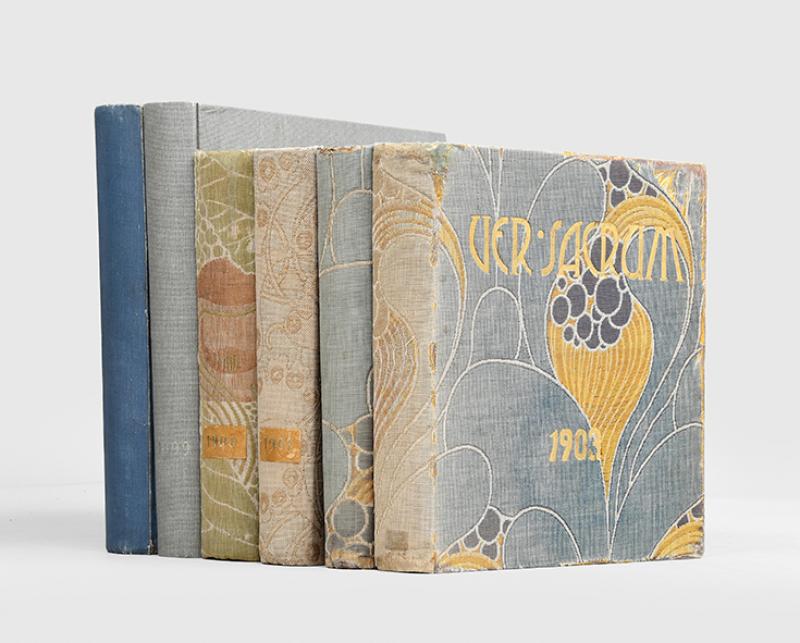
VIENNA SECESSION.

Ver Sacrum: Organ der Vereinigung Bildender Künstler Österreichs. Vienna and Leipzig: Gerlach & Schenk; E.A. Seemann, 1898-1903. ¶ 120 numbers bound in 6 annual volumes, quarto; the first two volumes 289 x 282 mm, the latter four 254 x 238 mm. Illustrated with 471 reproductions of drawings, 55 lithographs, and 216 woodcuts (most printed in colour). This set includes the extra number for the first year (catalogue of the Second Secession Exhibition) and the Calendar number for the sixth year. Vols. I-II in 20th-century blue and grey cloth, front covers lettered in gilt, patterned endpapers, top edges gilt, others trimmed; Vols. III-VI in floral-patterned cloth, patterned endpapers, top edges gilt, other uncut. Original wrappers bound in vols. I-III. Vols. II and IV with “Feuerbacher Heide” bookplate of industrialist Hans Lutz Merkle (1913-2000). Slight fraying at extremities and minor sunning to spines, contents with some spotting and toning but generally clean and bright, Vol. I with some cropping of pagination at foot and minor loss to wrapper of August 1898 issue. An excellent set. ¶ First editions, a very scarce complete run of one of the most consequential artistic journals ever published, the organ of the Vienna Secession, bound in annual volumes, the latter four in floral cloth bindings likely by the Wiener Werkstätte. The Vienna Secession was a group of Austrian artists, led by Gustav Klimt, who, in 1897, broke away from the conservative Künstlerhaus to promote modern art and the ideal of the Gesamtkunstwerk, or total work of art. Ver Sacrum (“Sacred Spring”) was their journal, which sought to integrate ornament, typography, layout, design, and text into a unified artwork. It included photographs of the Secession’s own exhibitions, and texts were contributed by many leading poets and writers of the day. Literary and artistic contributors included Max Kurzweil, Rainer Maria Rilke, Maurice Maeterlinck, Hugo von Hofmannsthal, Alphonse Mucha. “Ver Sacrum remains a document of the first importance for any student of the period, and one without which it would be impossible to obtain a complete picture of the activity of the Secession” (Vergo, p. 44). The introductory essay declared that it “aims to show other countries for the first time that Austria is an independent artistic entity... it is meant to be a clarion call to the artistic sense of the people, to inspire, promote, and spread artistic life and artistic independence” (translated). The bindings of the latter four volumes are in the style of the Wiener Werkstätte, founded in 1903 to promote high standards of Austrian craft. They were likely designed by Koloman Moser, who organized Ver Sacrum and later co-founded the Werkstätte. Their floral patterns, indebted to the English Arts and Crafts movement, reflect the aim of uniting binding and contents in keeping with the Gesamtkunstwerk ideal. A total of 120 numbers were issued from January 1898 to December 1903, forming six annual volumes: monthly for the first two years, and bimonthly thereafter. The print run of the early issues is unknown, though there were 300 subscribers by 1900, and 600 copies were printed for the sixth year (Nebehay, p. 32). ¶ Christian M. Nebehay, Ver Sacrum, 1977; Peter Vergo, Art in Vienna, 1993.

Sachgebiete: Österreich, Design, Illustrierte Bücher, Moderne Kunst

28.07.2026 - 23:13

78000,- EUR

Peter Harrington
...

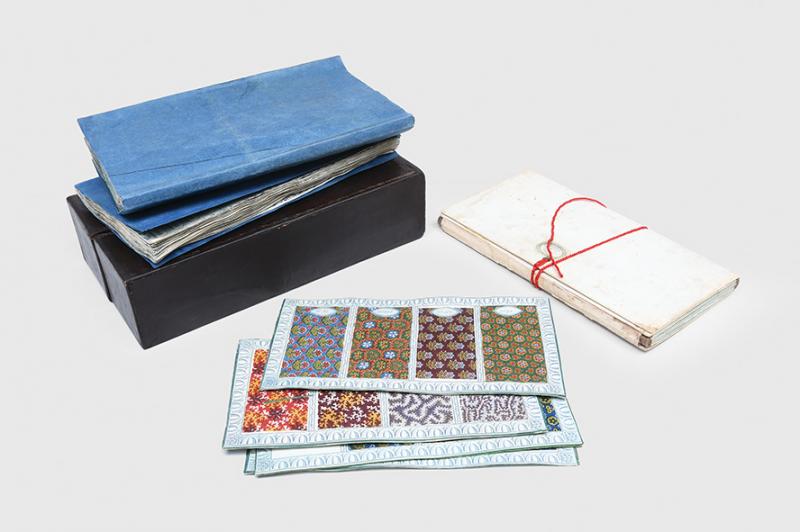
TEXTILES AND DESIGN.

Pair of salesman’s pattern books, containing over 1,000 finely woven textile samples. [Likely Norwich: c.1820s]. ¶ 2 vols, tall octavo (260 x 150 mm). With 1,063 unique samples of varying sizes, mounted on rectos of 125 leaves printed in ornamental blue (2 folding at fore edge), manuscript titles and numbers direct to leaves or on labels. Contemporary blue paper wrappers, manuscript number or label on inner front covers. Housed in 19th-century calf pull-off box, green lining and gilt decoration. Within custom blue cloth box with red label by James Brockman. Samples fine and bright, wrappers creased, pull-off box worn: a well-preserved collection. ¶ A prepossessing collection of textile swatches for clothing or furnishing, likely produced in Norwich for selling to the German market. Using the whole spectrum of colours, the designs incorporate stripes, geometric shapes, diaper patterns, zigzags and chevrons, floral and foliate motifs, and ikat designs. The samples are arranged by pattern under titles in German and, at times, French and Italian. These include, for example, Weisbodige Croisé (white strips and colour chevron-pattern stripes), Rothbodige Köper (thick red stripes alternating with those of other colours), and Cuttni (multicolour swatches with fine diaper or lozenge patterning). The samples are woven from wool, a factor - together with their design - that points to their origin in Norfolk. “The presentation of choice in the books of samples from Norwich is literally fascinating, with some pages so stunning and dazzling in their effect and we might argue that it could be the effect of the whole page that seduces the buyer, rather than the individual sample... The almost infinite variations of colour and pattern, accentuated in their intensity in the context of a book or card, create an eye-catching and infectious spectacle” (Mitchell). Accompanying these books are two other unrelated sets of several dozen samples, both dating from later in the 19th century and at least one from France. Provenance: Cora Ginsburg (1910-2002), the expert in fine textiles, purchased by her in England in 1962 - Stephen C. Massey. ¶ Victoria Mitchell, “A Marketplace in Miniature: Norwich Pattern Books as Cultural Agency.”

Sachgebiete: Mode, Möbel, Textilien, Großbritannien

28.07.2026 - 23:11

18000,- EUR

Peter Harrington

...

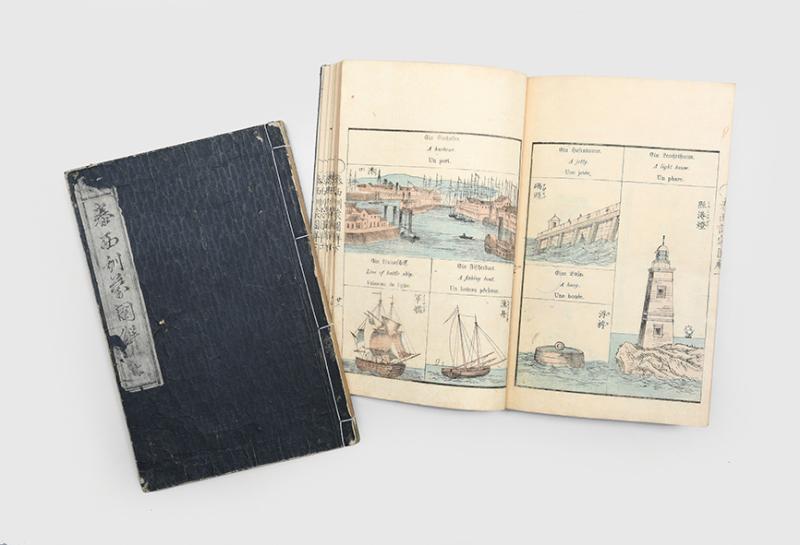
TANAKA, Yoshio.

Taisei kunmo zukai (“An Illustrated Encyclopaedia of the West”). [Tokyo:] Monbusho, 1871. ¶ 2 vols, octavo. Colour woodblock and copperplate illustrations throughout; text in Japanese, English, French, and German. Original black patterned wrappers, renewed white string fukuro-toji binding, original printed label on front wrappers. Housed in modern blue cloth folding case with manuscript title label. Red ink seals of the English literature scholar Masaaki Sogo (1912-1993), remains of former printed label on inner rear wrapper of vol. I. Wrappers generally rubbed and creased, a little loss to labels, contents bright with minor worm-holing repaired: a very good copy. ¶ First edition of this colourful illustrated encyclopaedia, produced by the Ministry of Education to introduce various Western items and their names in English, French, and German. It was released only four years into the Meiji period by Tanaka Yoshio, a prominent naturalist and zoologist who oversaw the founding of the National Museum of Natural History and Ueno Zoo. Taisei kunmo zukai adopts the format of traditional Japanese encyclopaedias but applies multi-lingual captions. It opens with examples of European architecture, houses, and furniture, before moving to kitchen utensils, tools, clothing, gardening equipment, domestic animals, sports, railways, ships, and weaponry. The categorisation reflects the ongoing process of modernising scientific and technical knowledge in Japan. For example, as noted by W. Puck Brecher, the separation of animals into “domesticated” and “wild” subsections was a holdover from the early modern period, where animals were classified by their usefulness or danger to society. Taisei kunmo zukai “interprets ‘wild’ not simply as undomesticated, but as unmanageably savage and ferocious... The wildlife section includes illustrations of a hunter and a forest to instruct readers about the propriety of human dominion over the wild” (Brecher, p. 86). This contrasts with emerging Western models of zoological classification, showing how the late 19th century was in a state of flux between traditional and modern ideas. ¶ W. Puck Brecher, Loving and Loathing Wildlife in Japan, 2025.

Sachgebiete: Asien, Lexika, Illustrierte Bücher, Japan

28.07.2026 - 23:09

3300,- EUR

Peter Harrington